For more than two decades, MetaTrader has dominated the retail trading industry. Yet in 2026, one question continues to divide traders: MT4 vs MT5—which platform should you actually use?
If you search online, you’ll find countless comparisons listing features, indicators, and timeframes. However, most of these articles miss the real question.
Professional traders don’t choose a platform based on how many built-in indicators it offers. They choose the platform that best supports their trading style, execution requirements, automation needs, and long-term scalability.
The truth is that both platforms remain relevant in 2026. However, they serve different types of traders.
Let’s examine what professional traders actually use, where each platform excels, and whether MT4 or MT5 is the better choice for your trading goals.

The Evolution of MetaTrader
When MetaTrader 4 was released in 2005, it quickly became the industry standard for Forex trading.
Its lightweight architecture, extensive broker support, and massive ecosystem of Expert Advisors (EAs) made it the preferred choice for retail traders worldwide.
MetaTrader 5 was introduced as its successor, offering:
- more timeframes
- additional order types
- multi-asset trading capabilities
- improved strategy testing
- enhanced performance
Despite these advantages, many traders continued using MT4 due to familiarity and the enormous library of existing indicators and EAs.
Fast forward to 2026, and the landscape has changed significantly.
Most new development is now focused on MT5, while MT4 remains heavily used by legacy traders and brokers.
MT4 vs MT5: The Biggest Differences
At first glance, both platforms appear similar.
However, beneath the interface, there are major architectural differences.
Asset Coverage
MT4 was designed primarily for Forex trading.
MT5 was built as a multi-asset platform capable of supporting:
- Forex
- stocks
- futures
- commodities
- indices
- cryptocurrencies
For traders who only trade currency pairs, this may not seem important.
However, many professional traders increasingly diversify across multiple markets, making MT5 a more flexible solution.
Timeframes
MT4 provides 9 timeframes.
MT5 offers 21 native timeframes.
This gives traders greater flexibility when analyzing market structure and refining entries.
While custom indicators can create additional timeframes in MT4, MT5 delivers them natively without requiring workarounds.
Economic Calendar Integration
One feature often overlooked in MT5 is the built-in economic calendar.
Professional traders can monitor high-impact events directly within the platform without relying on third-party websites.
For traders managing multiple positions during major economic releases, this functionality can be extremely valuable.
MT4 vs MT5 Execution Speed
One of the most searched questions today is:
Does MT5 execute trades faster than MT4?
The answer is more nuanced than most traders realize.
Execution speed depends primarily on:
- broker infrastructure
- server location
- network quality
- VPS latency
- liquidity routing
The platform itself plays only a partial role.
That said, MT5’s newer architecture processes data more efficiently and handles larger volumes of information with less resource consumption.
For traders running multiple charts, indicators, and automated systems simultaneously, MT5 generally delivers smoother performance.
In real-world trading environments, the difference is rarely measured in seconds. Instead, it becomes noticeable through:
- faster chart updates
- improved platform responsiveness
- more efficient order management
- better handling of complex strategies
For professional traders using VPS hosting and low-latency broker connections, MT5 often provides a more scalable environment.
MT4 vs MT5 for Expert Advisors (EAs)
Automation is where the platform decision becomes much more important.
Many traders still use MT4 because thousands of existing Expert Advisors were built using MQL4.
Migrating those systems to MT5 often requires code modifications or complete rewrites.
As a result, some profitable trading systems remain locked within the MT4 ecosystem.
However, for new development, most professional algorithmic traders now prefer MT5.
Why?
More Powerful Programming Language
MT5 uses MQL5, which offers:
- object-oriented programming
- improved execution efficiency
- advanced data handling
- greater flexibility for complex algorithms
This allows developers to build more sophisticated trading systems than were possible with MQL4.
Better Backtesting
Backtesting quality can significantly influence strategy development.
MT5 provides:
- multi-threaded testing
- faster optimization
- multi-currency testing
- distributed cloud testing
For quantitative traders and system developers, these advantages can save countless hours during strategy research.
Superior Optimization Tools
Professional algorithmic traders often run thousands of strategy variations before deploying a system.
MT5’s optimization engine makes this process considerably faster and more practical.
For traders focused on automation, MT5 is increasingly becoming the preferred platform.

Why Many Professional Traders Still Use MT4
Despite MT5’s technical advantages, MT4 remains surprisingly popular.
There are several reasons for this.
Existing Infrastructure
Many traders have spent years building:
- custom indicators
- Expert Advisors
- scripts
- templates
- workflows
Switching platforms requires time, testing, and validation.
For traders running profitable systems, the incentive to migrate may be limited.
Simplicity
MT4 is lightweight and easy to use.
Many discretionary traders prefer its straightforward interface and minimal learning curve.
For traders who focus exclusively on Forex and do not require advanced functionality, MT4 continues to perform effectively.
Broker Compatibility
Although MT5 adoption continues to grow, MT4 remains widely supported by brokers around the world.
This allows traders to continue using familiar tools without major disruptions.
Why More Professionals Are Moving to MT5
While MT4 remains active, the long-term trend is becoming increasingly clear.
Most new innovation is occurring on MT5.
Professional traders are migrating because they need:
- advanced automation
- faster testing
- multi-asset capabilities
- improved analytics
- long-term platform support
Broker technology providers are also prioritizing MT5 integrations, creating additional incentives for traders to adopt the newer platform.
The question is no longer whether MT5 is technically superior.
The real question is whether your trading workflow currently requires those advantages.
Which Platform Is Best for Forex Trading?
The answer depends entirely on the trader.
MT4 Is Ideal For:
- traders using legacy EAs
- discretionary Forex traders
- users who value simplicity
- traders with established MT4 workflows
- beginners looking for a straightforward platform
MT5 Is Ideal For:
- algorithmic traders
- multi-asset traders
- quantitative researchers
- traders developing new EAs
- traders seeking advanced testing capabilities
- professionals building long-term trading infrastructure
The Role of VPS Hosting Regardless of Platform
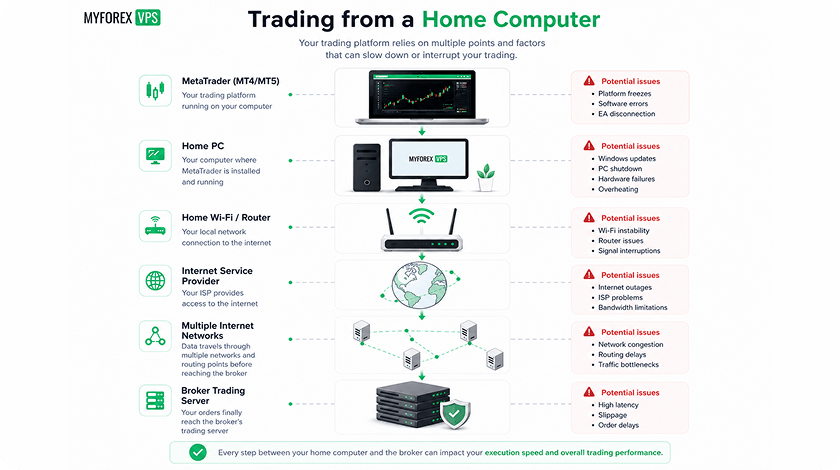
One mistake traders often make is focusing entirely on the platform while ignoring infrastructure.
Whether you use MT4 or MT5, execution quality depends heavily on your trading environment.
A professional VPS helps ensure:
- low latency connections
- faster order routing
- stable platform operation
- uninterrupted automated trading
- 24/7 availability
For traders running Expert Advisors, VPS hosting often has a greater impact on real-world performance than the choice between MT4 and MT5 itself.
A poorly connected MT5 installation can easily underperform a properly optimized MT4 setup running on a low-latency VPS.
Final Verdict: Should You Use MT4 or MT5 in 2026?
If you’re already running profitable systems on MT4, there may be no urgent need to migrate.
The platform remains stable, reliable, and widely supported.
However, if you’re building new strategies, developing Expert Advisors, or planning for long-term growth, MT5 is increasingly becoming the logical choice.
Professional traders in 2026 are not abandoning MT4 overnight. But the direction of the industry is clear.
MT4 remains the platform of legacy systems.
MT5 is the platform of future development.
For most new traders entering the market today, MT5 offers greater flexibility, stronger analytical tools, superior backtesting capabilities, and better support for the evolving demands of modern trading.
The best platform for Forex trading ultimately depends on your objectives—but for traders thinking beyond today, MT5 is rapidly becoming the professional standard.