Technical Mistakes Most Traders Ignore
Note: This article is an analytical overview of common technical failures in live EA trading. It is not a guide to profitability and should not be interpreted as trading advice.
Introduction: When Automation Meets Reality
Forex Expert Advisors are often sold as a logical next step for traders seeking consistency, discipline, and freedom from emotional decision-making. The promise is appealing: test a strategy on historical data, deploy it live, and let statistics do the work.
Yet reality tells a different story.
At MyForex, we regularly speak with traders who share the same frustration. Their EA looked profitable in backtests, behaved acceptably in demos, and then started losing money in live trading – sometimes slowly, sometimes catastrophically. The usual conclusion follows quickly: “The EA doesn’t work.”
In most cases, that conclusion is wrong.
Forex EAs rarely fail because the underlying idea is fundamentally flawed. They fail because live trading exposes technical weaknesses that backtests never reveal. Automation does not simplify trading – it shifts the difficulty from decision-making to execution, infrastructure, and system design.
This article explains why Forex EAs fail in live trading, focusing on the technical mistakes most traders ignore, even experienced ones.
What a Forex EA Really Is – and What It Is Not
A Forex Expert Advisor is commonly described as an automated trading program for platforms like MetaTrader 4 or MetaTrader 5. That definition is accurate, but incomplete.
In practice, an EA is not a trader nor an analyst. It is a reactive system that responds to incoming price data, broker execution rules, and server conditions. It does not interpret context, adapt intuitively, or “understand” market behavior. It simply executes instructions as fast – or as slowly – as the environment allows.
This distinction matters because many traders judge EAs as abstract strategies, while live markets judge them as technical systems. When those systems are deployed into conditions they were never designed for, failure is not a surprise – it is inevitable.
Beginner vs Professional EA Mistakes (Quick Comparison)
| Beginners |
Professionals |
| Trust backtests blindly |
Forward-test live |
| Ignore VPS quality |
Optimize latency |
| Use default settings |
Customize execution |
| Per-trade risk only |
Portfolio risk control |
Why Backtests Create Confidence That Live Trading Destroys
Backtests are clean by design. They assume that historical prices can be replayed with minimal friction, that orders are filled without resistance, and that spreads behave predictably. This creates a controlled environment where strategy logic dominates outcomes.
Live trading removes that control.
In real markets, an EA does not trade historical candles. It competes for liquidity in real time. Prices move while orders are being sent. Spreads widen when liquidity disappears. Execution queues form precisely during moments of opportunity.
From our experience at MyForex, one pattern repeats relentlessly:
The closer an EA operates to the market’s microstructure, the more dangerous unrealistic backtests become.
Scalping systems and short-term EAs are especially vulnerable. Their statistical edge is small, and execution costs quickly overwhelm it.
The Execution Gap: Where Most EAs Quietly Break
The single most underestimated factor in EA performance is execution quality.
In live trading, every order is shaped by:
- how quickly it reaches the broker,
- how the broker routes it to liquidity providers,
- whether sufficient liquidity exists at the requested price.
This creates what we call the execution gap – the difference between how a trade is assumed to execute in theory and how it actually executes in practice.
In our account reviews, we have seen EAs with stable backtests fail simply because average slippage increased by one pip. That may sound insignificant, but for systems targeting two or three pips per trade, it is devastating.
The strategy did not change.
The math did.
Slippage: The Invisible Cost That Turns Profits into Losses
Slippage rarely causes dramatic blow-ups. Instead, it erodes performance quietly.
One real MyForex case involved a scalping EA with a historical expectancy of roughly half a pip per trade. In live conditions, average negative slippage reached 0.7–0.8 pips during active sessions. The win rate remained high. The system appeared “mostly fine.”
It wasn’t.
Over several weeks, the account drifted steadily downward. No single trade looked alarming. The cumulative effect was fatal. This is how many traders lose confidence in automation without ever identifying the real problem.
Slippage is not a bug. It is a structural reality. Ignoring it does not make it disappear – it simply compounds its damage.
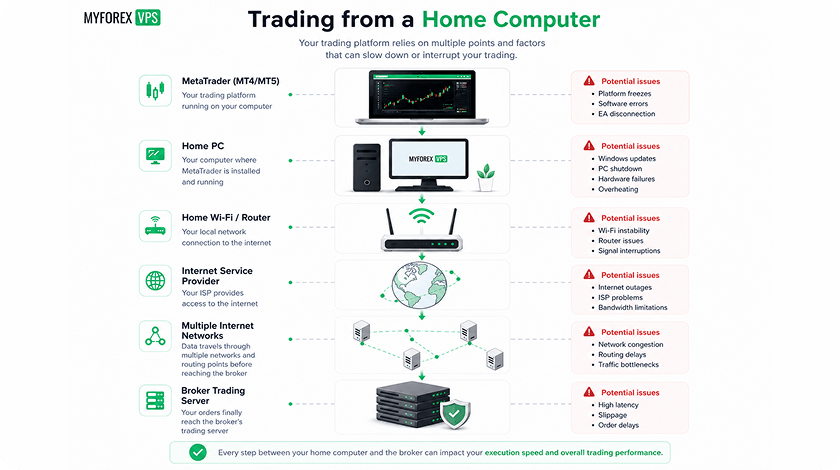
VPS Infrastructure: When Milliseconds Decide Outcomes
Traders often underestimate infrastructure because it feels separate from trading logic. In automated trading, that separation does not exist.
We have repeatedly observed the same EA produce materially different results depending on VPS quality. In one controlled comparison, the only variable was infrastructure:
- the same broker,
- the same account type,
- the same EA settings.
The difference came from latency and resource allocation.
On a shared, low-cost VPS, execution delays averaged 150–200 milliseconds higher. Slippage increased noticeably during peak sessions. Over a month, performance lagged the low-latency setup by more than 18%.
Nothing in the strategy changed.
Only the environment did.
For automated systems, infrastructure is not a convenience. It is part of the strategy itself.

Spread Reality: When the Market Chooses the Worst Moment
Backtests usually assume fixed or averaged spreads. Live markets are far less polite.
Spreads widen during rollover, thin liquidity distorts pricing during quiet sessions, and volatility spikes around news events. An EA without proper spread awareness will continue trading regardless, entering positions under conditions that fundamentally alter risk-reward dynamics.
From a trader’s perspective, this often looks like “bad luck.” From a technical perspective, it is predictable behavior under ignored constraints.
Markets are not obligated to provide stable conditions simply because a strategy requires them.
Broker Differences That Break “Universal” EAs
One of the most common surprises for traders is seeing the same EA behave differently across brokers. This is not a mystery.
Brokers differ in execution models, stop-level enforcement, liquidity aggregation, and swap calculations. An EA optimized under one set of assumptions may violate another broker’s rules without obvious error messages.
We have audited cases where tight stop logic worked perfectly on one broker and caused order rejections or distorted risk on another. The EA appeared unreliable. In reality, it was structurally incompatible with its new environment.
Automation does not eliminate broker dependency – it amplifies it.
Over-Optimization: When Precision Creates Fragility
Over-optimized EAs often look impressive. Smooth equity curves and low drawdowns inspire confidence. Unfortunately, that confidence is usually misplaced.
These systems are finely tuned to historical conditions that no longer exist. When volatility regimes shift or market structure changes, the EA does not adapt – it persists.
Many dramatic EA failures are not sudden breakdowns, but delayed consequences of fragile design. The system works until it doesn’t, and when it stops working, recovery is unlikely.
The Risk Traders Don’t See Until It’s Too Late
Automation hides risk exceptionally well.
Multiple positions open silently. Correlated exposure accumulates across pairs. Drawdown accelerates faster than intuition expects. Traders often realize the true risk only after margin pressure appears.
In our reviews, more than half of failed EA accounts underestimated portfolio-level exposure, even when per-trade risk looked conservative. Automation didn’t reduce risk – it obscured it.
A Typical EA Failure, Seen Repeatedly
A realistic scenario we encounter often looks like this:
A scalping EA shows strong backtest results. It is deployed on a shared VPS. Live slippage averages between one and two pips. Spreads widen during rollover. Over several weeks, the drawdown exceeded expectations. The EA is stopped.
The trader blames the strategy.
The real cause is technical: execution quality and infrastructure were never aligned with the system’s assumptions.
How Professionals Approach EA Trading Differently
Professional system traders do not search for perfect robots. They engineer environments.
They forward-test under real spreads, monitor execution metrics, adapt risk dynamically, and treat EAs as evolving systems rather than static products. Most importantly, they accept that automation increases responsibility rather than eliminating it.
Final Expert Insight from MyForex
Forex EAs do not fail because automation is flawed.
They fail because live markets are less forgiving than backtests suggest.
If you treat automated trading as an engineering discipline, EAs can work.
If you treat them as shortcuts, the market will expose every weak assumption you made.
FAQ: Why Forex EAs Fail in Live Trading
Q: Why do Forex EAs work in backtests but fail live?
A: Because backtests do not accurately simulate real spreads, slippage, execution delays, liquidity gaps, or broker-specific rules present in live trading.
Q: Are Forex EAs profitable in live trading?
A: Yes, but only when execution quality, VPS infrastructure, broker compatibility, and risk management are professionally engineered.
Q: Does VPS quality really matter for Forex EAs?
A: Yes. High latency, CPU throttling, and network instability directly reduce execution accuracy and profitability.
Q: Why does the same EA perform differently on different brokers?
A: Brokers differ in liquidity sources, execution speed, stop-level rules, and swap policies, all of which affect EA behavior.
Q: What is the biggest mistake EA traders make?
A: Trusting backtests while ignoring live execution conditions and infrastructure.