Two traders run the same strategy.
Same pair, same broker, same entries. On paper, their results should be identical. In reality, one account grows steadily while the other slowly degrades. Not through one big mistake, but through a series of small, almost invisible differences that accumulate over time. At first, it looks like randomness. Then like bad execution. Eventually, it gets blamed on the strategy itself.
But the strategy isn’t what changed.
The difference lies in something most traders don’t treat as part of the system at all — the environment in which that system runs.
The Layer Most Traders Don’t See
Retail trading culture tends to focus almost entirely on logic: entries, exits, indicators, models. The assumption is simple — if the strategy is good, the results will follow. And if the results are плохие, the strategy must be wrong.
That assumption holds in backtesting, where everything is clean, controlled, and repeatable.
It breaks down the moment you go live.
Because live trading introduces a second layer — execution. Not just whether a trade is placed, but how, when, and under what conditions it reaches the market. The same system running on a home machine and on a properly configured forex VPS is not operating under the same constraints, even if everything else appears identical.
That difference is subtle. It rarely shows up in a single trade. But over time, it reshapes the entire performance profile of a strategy.
Forex VPS vs Home PC — Comparison Table
| Factor |
Home PC |
Forex VPS |
| Latency |
Unstable (20–150 ms, fluctuating) |
Stable (1–5 ms near broker servers) |
| Execution Consistency |
Varies depending on network/load |
Predictable and consistent |
| Uptime |
Depends on user (PC, internet, power) |
24/7 continuous operation |
| Slippage |
Higher and inconsistent |
Reduced and more controlled |
| Environment |
Shared (apps, updates, background) |
Dedicated trading environment |
| Reliability |
Medium (random interruptions) |
High (data center infrastructure) |
| Maintenance |
Manual (updates, restarts) |
Managed or minimal |
| Performance Stability |
Drifts over time |
Stable under same conditions |
| Best For |
Manual / swing trading |
EAs, scalping, AI trading |
What Really Happens on a Home PC
Trading from a personal computer feels straightforward because it’s familiar. You install the platform, connect to your broker, and everything seems to function as expected. For manual trading with longer holding periods, this setup is often sufficient.
The problems start when precision begins to matter.
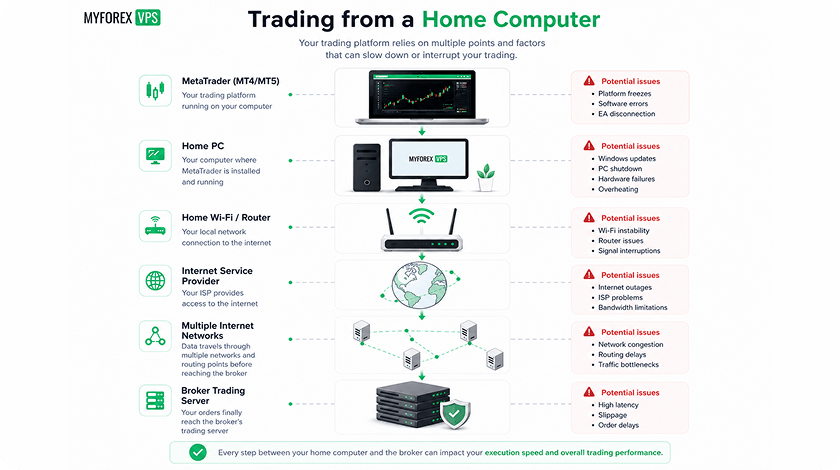
A home connection is rarely unstable in a dramatic sense. It doesn’t disconnect constantly or fail outright. Instead, it fluctuates. Latency shifts depending on network load, routing changes, and time of day. These changes are small enough to go unnoticed in everyday use, but they introduce inconsistency into execution. A trade that should be filled immediately might be delayed just enough to alter the entry price. Not by much — but enough.
At the same time, the machine itself is not dedicated to trading. It’s handling background processes, updates, and whatever else is running in parallel. None of this is catastrophic on its own. But it creates a layer of unpredictability. Occasional freezes, minor delays, brief disconnects — each one insignificant, but together they distort the conditions under which the strategy operates.
This is why results on a home setup often feel inconsistent. Not completely broken, but slightly off. A strategy that looks stable in testing starts to drift. Win rates drop a few percentage points. Drawdowns deepen slightly. Over time, that drift compounds into something meaningful.
What Changes on a Forex VPS
A forex VPS doesn’t fundamentally change what your strategy does. It changes how consistently it is able to do it.
When the system runs in a data center close to broker infrastructure, latency becomes not only lower, but stable. That stability is the key difference. Instead of fluctuating delays, execution happens within a narrow, predictable range. Orders are sent and received under consistent conditions, which means the strategy behaves closer to how it was designed and tested.
The environment itself is also simplified. There are no competing processes, no unexpected updates, no interruptions caused by unrelated activity. The system runs continuously, without depending on whether your local machine is on, connected, or under load. This removes a layer of randomness that most traders never explicitly account for, but which affects every trade.
The effect is not dramatic in isolation. You don’t suddenly double your performance. What changes is more subtle — the erosion stops. The small inefficiencies that were previously eating into results are reduced, and the strategy begins to behave in a more stable, predictable way.
A Difference You Only Notice Over Time
Consider a relatively simple automated system running on MetaTrader 5. On a home setup, it produces mixed results. Nothing obviously wrong, but performance is weaker than expected. Trades are occasionally entered late, exits are slightly off, and slippage is more frequent than anticipated. After a few weeks, the equity curve begins to flatten, then decline.
The same system is then moved to a VPS environment located near the broker’s servers. Nothing else changes — same logic, same parameters, same market conditions. Over the following weeks, execution becomes more consistent. Entries align more closely with expected prices. Slippage decreases. The overall behavior of the system stabilizes.
The strategy itself did not improve. What changed was the set of conditions under which it operated.
When the Difference Matters
For some trading styles, this distinction is less important. If positions are held for days and decisions are made manually, small variations in execution have limited impact. In those cases, a home setup can be entirely adequate.
But the moment a strategy depends on timing, frequency, or automation, the environment becomes part of the system. This is especially true for Expert Advisors running in MetaTrader 4 or MetaTrader 5, for scalping approaches, for news-based trading, and for any form of AI-driven execution. In these contexts, small inconsistencies are no longer background noise. They directly affect outcomes.
The Question Most Traders Don’t Ask
The usual question is whether a forex VPS is worth it. It’s framed as an upgrade, something optional that might improve performance.
In practice, the more relevant question is whether the current setup is introducing variability that the strategy was never designed to handle.
Because if it is, then the results you’re seeing are not a pure reflection of the strategy. They are a combination of the strategy and the environment. And unless those conditions are controlled, it becomes difficult to separate one from the other.
Final Thought
It’s easy to believe that trading performance is driven primarily by strategy. That if the logic is solid, everything else will follow.
But live markets don’t operate in a controlled environment. They expose every assumption built into a system, including the ones that are never explicitly tested.
In that context, the difference between a system that almost works and one that holds up over time is rarely about intelligence or complexity.
It’s about whether the conditions it depends on are actually consistent.
FAQ
Do I really need a forex VPS?
You need a forex VPS if your trading depends on execution speed and stability. For automated trading, scalping, or AI systems, a VPS is essential. For manual long-term trading, it’s optional.
Is a forex VPS better than a home PC?
A forex VPS provides more consistent execution, lower latency, and higher uptime. A home PC can work, but introduces variability that may affect trading results.
How much latency is acceptable for forex trading?
For optimal performance, latency should be below 5 ms when connected to broker servers. Anything above 50 ms can start impacting execution quality in fast strategies.
Why does latency matter in forex trading?
Latency affects how quickly your order reaches the broker. Higher latency increases the risk of slippage, missed entries, and worse execution prices.
Can I run MetaTrader on a VPS?
Yes, both MetaTrader 4 and MetaTrader 5 can run on a VPS, allowing continuous trading without interruptions.
Is forex VPS worth it for beginners?
It depends on your strategy. Beginners using manual trading may not need it immediately, but anyone using automation should consider it early.