Broker Routing, MT Execution, and Infrastructure Mistakes Traders Ignore
Expert guide by MyForex
Introduction: The Most Confusing Problem in Forex Trading
Few things frustrate traders more than this situation:
Two people trade the same Forex strategy.
Same indicators. Same rules. Same timeframes.
Sometimes even the same EA file.
And yet the results are completely different.
One account shows steady growth.
The other struggles, bleeds, or collapses entirely.
For beginners, this feels unfair.
For experienced traders, it feels suspicious.
At MyForex, this is one of the most common questions we hear – and one of the most misunderstood problems in retail trading. The uncomfortable truth is simple:
In Forex, strategy logic is only one layer of the system.
Execution decides the outcome.
This article does not explain how to make money in Forex, nor does it promote any specific strategy, broker, or setup.
Its purpose is to clarify why identical trading logic can produce different results in live environments, and to highlight technical realities that are often ignored.

The Strategy Is the Same – the System Is Not
When traders say “the same strategy,” they usually mean the same rules for entering and exiting trades. From a conceptual standpoint, that makes sense.
From a technical standpoint, it is incomplete.
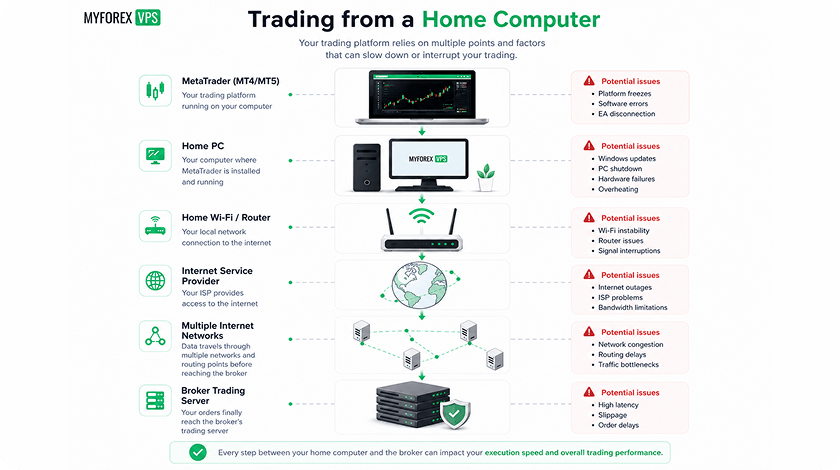
A live Forex trade is not just a decision. It is a process:
- price data is generated,
- transmitted to the trading platform,
- processed by the terminal,
- sent to the broker,
- routed to liquidity,
- filled (or rejected),
- and reported back.
Every step introduces variability.
Two traders may run identical logic, but they are not running the same system unless execution conditions are also identical. In practice, they never are.
Broker Routing: Where “Same Trade” Becomes a Different Trade
The first major divergence happens inside the broker.
Retail traders rarely see how orders are routed, but routing decisions shape execution more than any indicator ever will. Brokers differ in how they:
- aggregate liquidity,
- prioritize price vs speed,
- internalize or externalize orders,
- handle partial fills during volatility.
From the trader’s perspective, the chart looks the same.
From the market’s perspective, those orders are not equal.
We have reviewed cases where the same EA, trading the same pair at the same time, experienced:
- clean fills on one broker,
- consistent negative slippage on another,
- delayed execution during the session opens on a third.
The strategy did not change.
The path to liquidity did.
This is why experienced traders stop asking “Is the strategy good?” and start asking “How is this broker executing it?”
MT4 and MT5 Execution: The Hidden Layer Traders Ignore
MetaTrader platforms are often treated as neutral tools. They are not.
MT4 and MT5 handle price feeds, order queues, and execution logic differently – especially under load. During fast markets, execution is not continuous; it is discrete and queued.
This creates subtle but important effects:
- orders are processed in bursts, not instantly,
- price changes can occur between tick reception and order submission,
- execution priority can shift during volatility.
For discretionary traders, this is mostly invisible.
For automated strategies, it changes outcomes materially.
We have seen identical EAs produce different trade sequences purely because MT execution timing drifted by milliseconds. Over dozens or hundreds of trades, those small differences compound into large performance gaps.
This is not a bug. It is how retail platforms work.

Infrastructure Variance: Why Identical Logic Runs at Different Speeds
Infrastructure is where many traders unknowingly sabotage themselves.
Running the same strategy on:
- a home PC with unstable internet,
- a shared VPS,
- a low-latency VPS near the broker,
is not equivalent.
Even when everything “works,” the timing does not.
In controlled comparisons we’ve reviewed at MyForex, the same EA on different setups showed:
- latency differences of 100–250 milliseconds,
- measurable changes in average slippage,
- altered entry sequencing during high-activity periods.
Nothing dramatic happened on any single trade.
The divergence appeared slowly, trade by trade.
This is why traders often say:
“It worked for someone else, but not for me.”
They are usually right – and missing the real reason.
Latency Dispersion: The Invisible Edge Nobody Talks About
Latency is not just about being “fast.”
It is about being consistently predictable.
Two traders may both have “low latency,” but if one connection fluctuates while the other remains stable, execution quality will differ. This phenomenon – latency dispersion – is rarely discussed, yet critical.
Automated strategies assume that response times are roughly constant. When latency varies:
- entries shift,
- stops are triggered differently,
- fills degrade asymmetrically.
Over time, this changes the statistical profile of the strategy itself. The logic remains identical, but the realized behavior does not.
This is one of the main reasons identical strategies drift apart in live performance.
VPS vs Home PC: Convenience vs Control
Many traders start running strategies from home. Some never move beyond that. For manual trading, this is often fine.
For automated trading, it introduces uncontrolled variables:
- ISP routing changes,
- background processes,
- OS updates,
- power or connection interruptions.
A VPS does not magically make a strategy profitable, but it reduces randomness. More importantly, it reduces unobserved randomness – the kind traders don’t notice until damage is done.
We have seen cases where moving an EA from a home PC to a stable VPS did not increase profits – but stopped unexplained losses. That distinction matters.

Why These Differences Compound Over Time
One of the most dangerous misconceptions in Forex is the idea that “small execution differences don’t matter.”
They matter precisely because strategies repeat.
A one-pip disadvantage on a single trade is irrelevant.
A one-pip disadvantage applied hundreds of times is decisive.
This is why two traders can start with nearly identical equity curves and end up in completely different places months later. Execution differences compound quietly, invisibly, and relentlessly.
A Realistic Example We See Repeatedly
A common scenario looks like this:
Two traders deploy the same EA. One uses a VPS near the broker. The other runs it from a home PC. Both use reputable brokers. Both follow the same rules.
In the first few weeks, results look similar. Then, gradually:
- one account shows smoother equity,
- the other experiences deeper pullbacks,
- trades start diverging during volatile sessions.
Eventually, one trader questions the strategy.
The other keeps trading it.
The difference was never the strategy.
It was the system surrounding it.
What Experienced Traders Eventually Realize
At a certain level of experience, traders stop treating strategies as self-contained objects. They start treating them as deployments.
They understand that:
- brokers are not neutral,
- platforms are not transparent,
- infrastructure is not optional,
- and “same rules” does not mean “same outcomes.”
This shift in perspective is often what separates traders who cycle endlessly between strategies from those who achieve consistency.
Final Thought from MyForex
Forex trading is not just about ideas.
It is about how those ideas survive contact with reality.
If you deploy the same strategy into different execution environments, you should expect different results. Not because the market is unfair – but because systems behave according to their weakest assumptions.
Understanding that is not an edge.
Ignoring it is a liability.
FAQ: Why Identical Forex Strategies Produce Different Results
Why does the same Forex strategy produce different results on different accounts?
Because live Forex trading depends on execution. Even if the strategy logic is identical, differences in broker routing, platform execution timing, latency, and infrastructure cause trades to be filled at different prices and times, leading to different outcomes.
Can the same Forex EA trade differently on two brokers?
Yes. Brokers use different liquidity providers, routing logic, stop-level rules, and execution models. The same EA can experience clean fills on one broker and consistent slippage or order rejections on another, even with identical settings.
How much does latency really matter in Forex trading?
Latency matters when it is inconsistent. A stable 20 ms connection is usually less harmful than a fluctuating 80–200 ms connection. Latency dispersion causes unpredictable execution, which changes the statistical behavior of the same strategy over time.
Can VPS hosting change Forex strategy performance?
Yes. VPS location, CPU allocation, and network stability directly affect execution speed and consistency. The same strategy run on a low-latency VPS near the broker can perform noticeably differently than when run on a home PC or shared VPS.
Why does the same strategy backtest well but fail live on one account and not another?
Backtests do not simulate real routing, slippage, execution delays, or infrastructure variability. Live environments differ between accounts, so the strategy’s assumptions may hold for one setup and fail for another.
Is this difference caused by broker manipulation?
Usually no. In most cases, the difference comes from structural execution mechanics rather than intentional manipulation. Retail brokers operate under different technical constraints, and automated strategies are sensitive to those differences.
Can two traders get different results using the same Forex EA file?
Yes. Differences in VPS location, internet routing, platform load, broker execution, and account settings can cause the same EA file to behave differently, even if all visible parameters are identical.
Does this issue affect manual trading or only EAs?
It affects both, but automated strategies are far more sensitive. Manual traders adapt subconsciously to execution issues, while EAs execute blindly according to timing and price data they receive.
Is it possible to make identical results across accounts?
In retail Forex, perfectly identical results are unrealistic. Traders can reduce divergence by standardizing broker, VPS location, execution settings, and risk controls, but some variance will always remain.
What is the most common mistake traders make when comparing strategies?
Assuming that identical rules equal identical outcomes. In live trading, the execution environment is part of the strategy, not a neutral background.