8In modern Forex trading, success is no longer defined by strategy alone. Infrastructure — often overlooked by retail traders — has become a decisive factor. Among all technical variables, latency plays one of the most critical roles.
A difference of just a few milliseconds can determine whether your trade is executed at the intended price or slips into a loss. For algorithmic traders and scalpers especially, latency is not just a metric — it is a competitive edge.
This article breaks down what latency really means in Forex trading, how it affects performance, and why a Forex VPS can dramatically improve your results.

What Is Latency in Forex Trading
Latency refers to the time delay between sending a trading request and receiving confirmation from the broker’s server. It is measured in milliseconds (ms), and even extremely small delays can have measurable financial consequences.
Every trade you place follows a path:
- Your platform (MT4/MT5) sends an order
- The order travels across the network
- The broker’s server processes it
- A response is sent back
This entire round-trip time is your latency.
In ideal conditions, this process feels instantaneous. In reality, however, the speed of this interaction depends heavily on your physical location, network quality, and server infrastructure.
Why Latency Matters More Than Most Traders Think
Latency directly influences execution quality, which in turn affects profitability. The market does not wait for your order to arrive — prices continue to move while your request is in transit.
This leads to several key issues:
- Slippage — your order is executed at a worse price
- Missed entries — opportunities vanish before execution
- Delayed exits — profits shrink or losses increase
- EA inefficiency — automated strategies behave differently in live conditions
For high-frequency strategies, even a 50 ms delay can significantly distort results. What looks profitable in backtesting can become unstable in real trading purely due to execution delays.
Acceptable Latency for Different Trading Styles
Not all strategies are equally sensitive to latency. However, the faster your trading logic operates, the more critical execution speed becomes.
| Trading Style |
Recommended Latency |
Impact of High Latency |
| Scalping |
1–5 ms |
Severe performance loss |
| Algorithmic (EAs) |
1–10 ms |
Strategy distortion |
| Intraday trading |
10–50 ms |
Moderate impact |
| Swing trading |
50–200 ms |
Minimal impact |
For traders relying on precision and speed, latency above 20–30 ms already introduces measurable inefficiencies.
VPS vs Home Internet: A Critical Difference
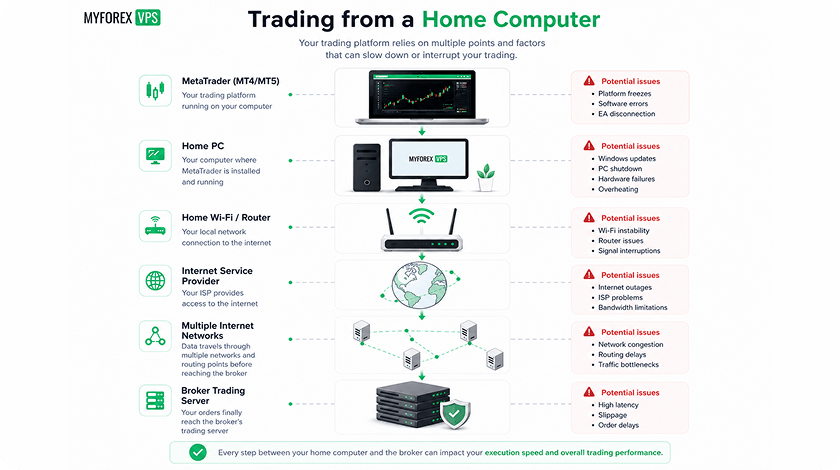
Many traders operate from a home PC, assuming their internet connection is sufficient. While this may work for manual trading, it introduces serious limitations for automated systems.
Here is a realistic comparison:
| Parameter |
Home Setup |
Forex VPS (NY4 / LD4) |
| Latency to the broker |
30–150 ms |
1–5 ms |
| Connection stability |
Variable |
Consistent |
| Uptime |
Limited |
24/7 |
| Risk of interruptions |
High |
Minimal |
A home connection depends on multiple unpredictable factors — ISP routing, Wi-Fi interference, and local outages. In contrast, a VPS located in a financial data center operates in a controlled environment with direct, optimized routing to broker servers.
The result is not just faster execution, but also predictable performance, which is essential for algorithmic trading.
Real Example: 1 ms vs 100 ms Execution
To understand the real impact of latency, consider a scalping strategy targeting small price movements.
| Metric |
VPS (1 ms) |
Home Connection (100 ms) |
| Entry execution |
Near-instant |
Delayed |
| Price accuracy |
High |
Lower (slippage) |
| Exit timing |
Precise |
Lagging |
| Average trade outcome |
+2–3 pips |
+0.5 pips or loss |
In this scenario, the strategy itself does not change — only the execution environment does. Yet the outcome shifts dramatically.
This is why many traders experience a gap between backtesting results and live trading performance. The missing variable is often latency.
The Role of Server Location (NY4, LD4)
Latency is heavily influenced by physical distance. Data cannot travel faster than the speed of light, and longer distances inevitably introduce delays.
Major Forex brokers host their servers in financial hubs such as:
If your trading system is located far from these centers, your orders must travel across continents, increasing latency.
For example:
- VPS in LD4 → Broker in LD4 = ~1–2 ms
- Europe → New York = ~70–100 ms
This is why professional traders prioritize co-location, placing their VPS as close as possible to the broker’s infrastructure.
How to Measure Your Latency
Understanding your current latency is the first step toward optimization.
Method 1: Inside MT4/MT5
Most platforms display server ping directly. This is the easiest way to check execution delay in real time.
Method 2: Ping Command
Using a basic network command allows you to test the response time to a server:
ping broker-server-address
While not perfectly identical to trading latency, it provides a useful estimate.
Method 3: VPS Provider Tools
Many Forex VPS providers offer test IPs, allowing you to evaluate latency before purchasing.
How to Reduce Latency in Forex Trading
Improving latency is primarily about optimizing infrastructure rather than strategy.
A VPS hosted near your broker drastically reduces execution delay.
2. Choose the Right Location
Always match your VPS location to your broker’s data center (e.g., NY4 or LD4).
3. Avoid Oversold VPS Plans
Cheap providers often overload servers, increasing latency despite proximity.
4. Minimize Local Dependencies
Running trading systems on personal devices introduces unnecessary risks and delays.
5. Optimize System Load
Even on a VPS, excessive processes can slow execution.
Latency and Slippage: The Hidden Cost
Latency is directly linked to slippage — one of the most underestimated trading costs.
When your order is delayed:
- the market price may change
- your trade is filled at a worse level
- your expected edge is reduced
Over hundreds of trades, even small slippage accumulates into significant losses.
In many cases, traders blame strategy performance without realizing that execution inefficiency is the real problem.
When Latency Is Less Important
Latency is not equally critical for all traders.
It has limited impact on:
- long-term position trading
- strategies targeting large price moves
- low-frequency manual trading
However, even in these cases, stability and uptime provided by a VPS can still be beneficial.
Conclusion
Latency is one of the most underestimated variables in Forex trading, yet it has a direct and measurable impact on profitability.
The key takeaway is simple:
- Faster execution leads to better pricing
- Better pricing leads to improved results
- Infrastructure can be just as important as strategy
In a market where thousands of participants compete simultaneously, the advantage often goes to those who act first — even if the difference is measured in milliseconds.
For traders serious about consistency and performance, reducing latency is not an optional upgrade. It is a fundamental requirement.
FAQ
What is a good latency for Forex trading?
A good latency for Forex trading is typically:
- 1–5 ms for scalping
- 1–10 ms for automated trading (EAs)
- below 50 ms for most strategies
Lower latency ensures faster execution and reduces slippage.
How does latency affect Forex profits?
Higher latency can lead to:
- worse entry and exit prices
- increased slippage
- missed trading opportunities
Over time, this reduces overall profitability, especially for fast trading strategies.
Does a VPS reduce latency in Forex trading?
Yes, a Forex VPS significantly reduces latency by placing your trading platform closer to the broker’s server. This can lower latency from 100 ms to as little as 1–5 ms.
What is the best VPS location for Forex trading?
The best VPS location is the one closest to your broker’s server. Most Forex brokers use:
- LD4 (London)
- NY4 (New York)
Choosing the correct location minimizes latency.
Can I trade Forex without a VPS?
Yes, but it comes with risks such as:
- higher latency
- unstable connection
- downtime
A VPS is strongly recommended for automated trading and scalping.
How can I check MyForex latency?
You can check latency by:
- viewing ping in MT4/MT5
- using the “ping” command
- testing VPS provider servers
This helps you understand your execution speed.