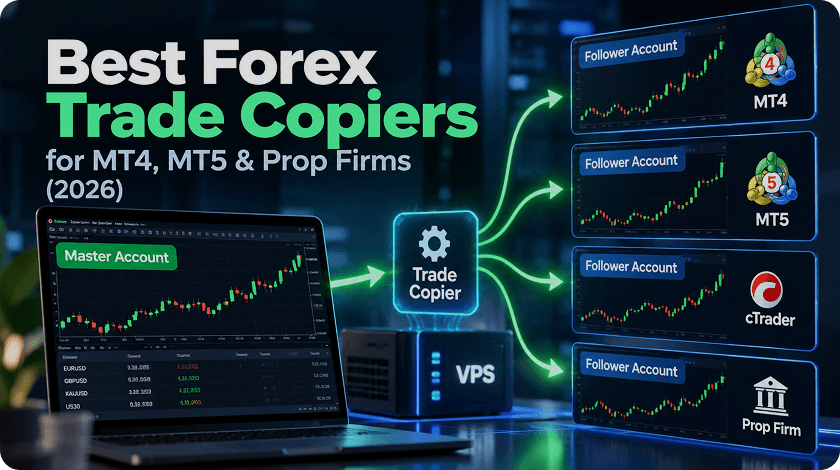
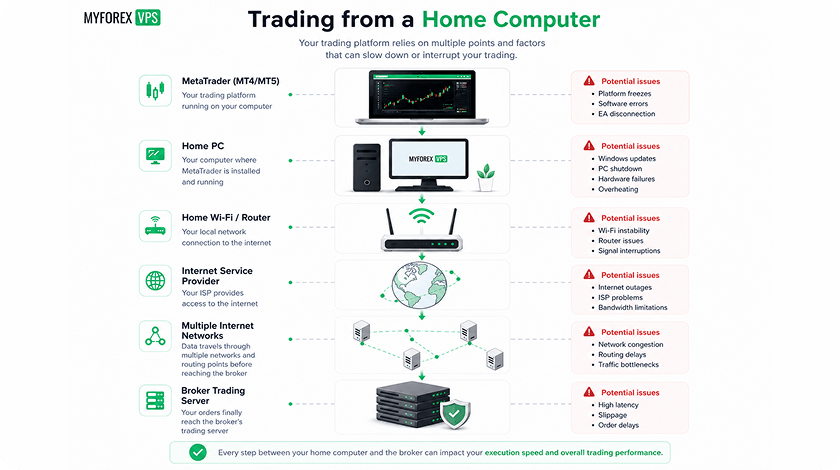
By 2026, the Forex trading infrastructure will have become a foundational element of trading performance, not a secondary technical detail. Automated strategies, Expert Advisors (EAs), copy trading systems, and multi-session execution models all rely on continuous platform availability, stable connectivity, and consistent order execution. In real trading conditions, even a well-designed strategy can underperform if the underlying infrastructure is unreliable.
From a risk-management and operational standpoint, technical stability directly affects execution quality, slippage, and exposure control. Platform disconnections, delayed order routing, or inconsistent uptime introduce variables that are difficult to quantify and impossible to manage within a trading plan. For this reason, professional traders treat infrastructure as part of their risk framework, not as an optional convenience.
As traders progress, many adopt a Forex VPS early — not to gain an advantage, but to remove avoidable technical risks from their decision-making process. Over time, this approach supports consistency, discipline, and scalability, which are core characteristics of professional trading. In this context, a Forex VPS is best understood not as a tool for beginners, but as a baseline operational requirement for anyone aiming to trade systematically and responsibly.
However, choosing a VPS solely based on price often leads to poor performance, unnecessary costs, or technical frustration. This guide explains how cheap Forex VPS hosting works in 2026, what specifications actually matter, and how to compare providers objectively – without bias toward any single service.
What Is a Forex VPS and When Do You Actually Need One?
A Forex VPS (Virtual Private Server) is a remote Windows server hosted in a professional data center. Instead of running MT4 or MT5 on a home computer, the trading platform operates on the VPS and can be accessed remotely at any time.
A VPS becomes especially relevant when trading conditions require reliability rather than convenience.
You are likely to benefit from a Forex VPS if you:
- Run Expert Advisors or automated strategies
- Trade during overnight sessions or major news events
- Experience unstable internet or power interruptions
- Need MT4 or MT5 running continuously without supervision
- Want more consistent order execution
You may not need a VPS yet if you:
- Trade manually and infrequently
- Operate only on higher timeframes such as H4 or D1
- Are still learning basic platform mechanics
For many traders, a VPS becomes essential not immediately, but at the point where consistency matters more than convenience.
Latency Explained Simply
Latency is the delay between clicking “Buy” or “Sell” and your broker receiving that command.
Typical scenarios:
- Home PC + Wi-Fi: 80–200 ms
- Standard VPS: 20–40 ms
- Broker-near Forex VPS: 1–5 ms
Why this matters:
- High latency increases slippage
- Orders may be filled at worse prices
- Fast strategies become unreliable
Who benefits most:
- Scalpers & news traders → latency critical
- EA users → latency + uptime
- Swing traders → uptime more important than speed
In practice, most retail traders do not need extreme infrastructure – but stable, predictable execution is essential.
What “Affordable Forex VPS” Means in 2026
In 2026, an entry-level Forex VPS typically costs between $10 and $15 per month and includes:
- 1–2 vCPU
- 2–4 GB RAM
- SSD or NVMe storage
- Windows Server 2019 or 2022
- Support for one or two MT4/MT5 terminals
This is usually enough to handle:
- One to three Expert Advisors
- Multiple indicator-heavy charts
- Continuous unattended operation
Common limitations of lower-cost VPS plans include:
- Shared CPU resources
- Limited performance bursts
- Basic technical support
Understanding these trade-offs helps traders choose realistically rather than optimistically.
How to Test a Forex VPS Before Long-Term Use
Before committing to any provider, test the VPS under real trading conditions:
- Check the latency to your broker
Use ping or terminal diagnostics.
<20 ms is acceptable, <5 ms is excellent.
- Run MT4/MT5 for at least 48 hours
Watch for freezes, disconnects, or restarts.
- Monitor CPU and RAM usage
Sustained 90–100% usage means the plan is too small.
- Test restart behavior
After reboot, MT should reconnect automatically.
- Contact support once
Response speed matters during live trading.
Cheap Forex VPS Providers in 2026
| Provider |
Price From |
Resources |
Locations |
Refund |
Notes |
| My Forex VPS |
$11.99 |
2–8 GB / 2–4 vCPU |
London, NY, Amsterdam |
7 days |
Forex-focused setup |
| Cloudzy |
$7.76 |
2–4 GB / 1–2 vCPU |
US, EU, Asia |
7 days |
Very low entry cost |
| FXVM |
$11.90 |
3–8 GB / 2–4 vCPU |
NY, London, Frankfurt |
Limited |
Beginner-friendly UI |
| ForexVPS.net |
$29.99 |
4–8 GB / 2+ vCPU |
22+ locations |
14 days |
Wide global coverage |
| BeeksFX |
$38 |
Dedicated resources |
NY4, LD4, Asia |
Limited |
Professional infrastructure |
| Liquidity Connect |
$30 |
4–8 GB / 1–4 vCPU |
London, NY, Tokyo |
By request |
Asia connectivity |
| Vultr |
$10 |
2–4 GB / 1–2 vCPU |
Global |
No |
DIY configuration |
| DigitalOcean |
$12 |
2 GB / 1 vCPU |
Global |
No |
Manual MT setup |
| Contabo |
$8.99 |
4–8 GB / 4 vCPU |
EU, US |
No |
High specs, mixed latency |
Expanded Competitor Insights
Cloudzy
Cloudzy is a low-cost VPS provider frequently used by traders who want to test Forex automation with minimal financial commitment. The service offers quick deployment, Windows VPS options, and multiple global data centers, which makes it accessible for entry-level use.
From an operational standpoint, Cloudzy relies on shared infrastructure, meaning server performance can vary depending on overall system load. While this may be acceptable for testing or light usage, it can introduce inconsistency for strategies that require stable resource availability over long periods.
Good for:
- First-time VPS users
- Testing EAs or simple automation
- Traders with very limited budgets
Trade-off:
- Performance consistency is not guaranteed under heavy load
- No Forex-specific optimization or trading-focused tooling
My Forex VPS
My Forex VPS is a Forex-focused VPS provider built specifically around the operational needs of MT4 and MT5 traders. Instead of offering generic cloud servers, the service provides preconfigured Windows environments that are compatible with MetaTrader platforms out of the box. This reduces setup complexity and lowers the risk of configuration errors that are common among new traders.
From a practical trading perspective, the infrastructure is designed for predictable long-term operation. Stable uptime, consistent resource allocation, and broker-friendly server locations help ensure that automated strategies continue running without interruptions. This is particularly relevant for traders using Expert Advisors, where unexpected restarts or performance spikes can materially affect results.
The provider is commonly used by traders who prefer a trading-oriented VPS environment rather than managing a general-purpose cloud server themselves.
Best suited for:
- Retail Forex traders running MT4 or MT5
- EA users who need stable, unattended execution
- Traders who value ease of setup and operational consistency
Trade-off:
- Less flexibility for advanced system-level customization compared to raw cloud VPS solutions
FXVM
FXVM positions itself as a user-friendly Forex VPS provider, emphasizing ease of use and transparency. The platform includes basic monitoring tools that allow traders to view CPU, memory usage, and VPS status, which helps new users better understand how their trading setup performs over time.
While FXVM supports multiple MT4 and MT5 terminals depending on plan size, its infrastructure is optimized more for accessibility than raw performance. As a result, it is suitable for most retail trading strategies but may not meet the requirements of latency-sensitive or high-frequency approaches.
Good for:
- Beginners who want visibility into VPS performance
- Traders prioritizing simplicity over advanced optimization
Trade-off:
- Storage and network performance are not top-tier
- Limited suitability for aggressive scalping strategies
ForexVPS.net
ForexVPS.net is an established provider with a strong reputation in the Forex VPS market. One of its key differentiators is extensive global coverage, with data centers in more than 20 locations. The built-in latency checker allows traders to make informed decisions about server placement relative to their broker.
This provider is often chosen by traders who work with multiple brokers or international accounts, where location flexibility and latency transparency are important. However, the pricing structure is higher than entry-level VPS solutions, which may exceed the needs of beginners.
Good for:
- Traders operating across multiple regions
- Users who prioritize broker proximity and latency analysis
Trade-off:
- Higher cost compared to basic Forex VPS options
BeeksFX
BeeksFX delivers institutional-grade hosting infrastructure, targeting professional traders, proprietary firms, and high-frequency strategies. Servers are located in premium financial data centers and are designed for extremely low latency and high network reliability.
From an EEAT perspective, the service demonstrates strong authority in infrastructure quality, but its capabilities are intentionally aligned with advanced trading operations. For most retail or beginner traders, the available performance level and pricing exceed practical requirements.
Good for:
- Professional and institutional traders
- Latency-critical and high-frequency strategies
Trade-off:
- Cost and complexity are not suitable for beginners
Generic Cloud VPS Providers
(Vultr, DigitalOcean, Contabo)
Generic cloud VPS providers offer flexible infrastructure and competitive hardware specifications. These platforms are not designed specifically for Forex trading, but they can be adapted by users with sufficient technical experience.
From a trust and usability standpoint, traders must handle manual MT4/MT5 installation, security configuration, Windows optimization, and performance tuning themselves. Latency optimization depends entirely on correct location selection and network routing.
Good for:
- Technically experienced traders
- Users who want full system-level control
Trade-off:
- No Forex-specific support or optimization
- Higher risk of misconfiguration for beginners
Final Thoughts for New Traders
A Forex VPS is not about finding the cheapest option – it’s about finding a reliable environment that matches your trading style.
Before choosing:
- Define how many terminals and EAs you need
- Check broker proximity
- Test performance before committing
- Avoid paying for unused features
A well-chosen VPS improves discipline, consistency, and execution quality, which are far more important than raw speed alone.
Used correctly, a Forex VPS becomes a practical tool – not an unnecessary expense – in a trader’s development journey.