Introduction
For decades, the image of a Forex trader was largely the same: a person sitting in front of multiple charts, analyzing price movements, watching economic news, and manually placing trades based on experience and market intuition.
That image still exists, but it no longer represents how a growing share of the global currency market operates.
Today, algorithms play a central role in modern Forex trading. From institutional trading desks and hedge funds to retail traders running Expert Advisors on MetaTrader, automation has become one of the defining characteristics of contemporary financial markets.
The rise of algorithmic Forex trading is not simply a technological trend. It is a response to the increasing speed, complexity, and competitiveness of global markets. Currency prices react to economic releases within seconds. Liquidity shifts constantly. Market opportunities appear and disappear faster than most human traders can react.
In this environment, automation offers a significant advantage.
Algorithms can monitor markets continuously, analyze multiple currency pairs simultaneously, execute trades in milliseconds, and follow predefined rules without emotional interference. They allow traders to transform trading ideas into systematic processes that can be tested, optimized, and scaled.
Yet despite the growing popularity of algorithm trading Forex systems, there remains considerable confusion around what algorithmic trading actually means. Some traders view it as a sophisticated discipline reserved for quantitative professionals. Others assume it simply involves purchasing a trading robot and letting it run unattended.
The reality is far more nuanced.
Successful algorithmic Forex trading combines strategy design, risk management, execution quality, and infrastructure reliability. A profitable currency trading algorithm is rarely the result of a single indicator or a few lines of code. Instead, it is the product of careful testing, continuous refinement, and disciplined execution.
This guide explores every major aspect of algorithmic trading in Forex, from the fundamentals of trading algorithms to practical examples, software platforms, and the critical role that Forex VPS hosting plays in maintaining stable and efficient automated trading operations.

What Is Algorithmic Forex Trading?
Algorithmic Forex trading refers to the use of computer programs to analyze market conditions and execute trades according to predefined rules.
Rather than making trading decisions manually, traders develop a set of instructions that define:
- When to enter a position
- When to exit a position
- How much capital to risk
- How to manage open trades
- Under what market conditions trading should occur
Once these rules are programmed into a trading system, the algorithm can monitor the market and execute trades automatically whenever the required conditions are met.
At its core, algorithmic trading is not about removing traders from the process. It is about creating a repeatable framework that can execute decisions consistently.
Consider a simple trading algorithm example.
A trader may decide to buy EUR/USD whenever the 50-period moving average crosses above the 200-period moving average. The system may also include a stop-loss of 30 pips and a take-profit target of 60 pips.
Every time these conditions occur, the algorithm executes the trade without hesitation.
The advantage is not necessarily that the strategy becomes more profitable. The advantage is consistency. The algorithm applies the same rules every time, regardless of market sentiment, recent losses, or emotional stress.
This ability to eliminate behavioural biases is one of the key reasons why algorithmic Forex trading continues to grow in popularity among traders of all experience levels.
Why Algorithms Are Reshaping the Forex Market
The growing adoption of FX algorithms is driven by fundamental changes in market structure.
The Forex market is the largest and most liquid financial market in the world. Trillions of dollars change hands daily across a decentralized network of banks, brokers, institutions, and individual traders.
This scale creates both opportunities and challenges.
While liquidity is abundant, market conditions can change rapidly. Price movements are influenced by economic releases, geopolitical developments, central bank decisions, and shifts in investor sentiment.
Human traders can analyze these factors, but they are limited by time, attention, and emotional discipline.
Algorithms do not face the same limitations.
A properly designed Forex trading algorithm can:
- Monitor dozens of currency pairs simultaneously
- Analyze multiple timeframes at once
- Process large amounts of market data
- Execute trades instantly
- Operate continuously throughout the trading week
More importantly, algorithms never become distracted, impatient, or overconfident.
Many trading failures occur not because the underlying strategy lacks an edge, but because traders fail to follow their own rules consistently. Fear causes premature exits. Greed encourages excessive risk-taking. Frustration leads to revenge trading.
Algorithms eliminate these behavioural weaknesses.
For traders who already possess a profitable strategy, automation often becomes less about improving entries and more about protecting the integrity of the trading process itself.
Algorithmic Trading vs Manual Trading
One of the most common questions among traders exploring automation is whether algorithmic trading is inherently superior to manual trading.
The answer depends on the trader’s objectives, experience, and strategy.
| Algorithmic Trading |
Manual Trading |
| Executes trades automatically |
Requires manual intervention |
| Operates 24/5 |
Limited by trader availability |
| Emotion-free execution |
Influenced by psychology |
| Processes large datasets quickly |
Limited analytical capacity |
| Requires technical setup |
Easier to start |
| Can monitor multiple markets simultaneously |
Typically focuses on fewer instruments |
Manual trading still offers advantages in situations that require discretion, contextual judgment, or interpretation of unexpected market events.
However, when a strategy relies on clearly defined rules, algorithmic execution often provides greater consistency and efficiency.
For this reason, many professional traders use a hybrid approach, combining discretionary market analysis with automated execution systems.

How Forex Trading Algorithms Work
Although trading systems vary significantly in complexity, most Forex algorithms follow a similar workflow.
Market Data Collection
Every algorithm begins with data.
The system collects information such as:
- Currency prices
- Bid-ask spreads
- Trading volume
- Volatility measurements
- Technical indicators
- Economic calendar events
The quality of this data is critical. Poor-quality inputs often lead to poor-quality trading decisions.
Signal Generation
The algorithm analyzes incoming data according to predefined rules.
For example:
- Is the market trending?
- Has volatility increased?
- Has a support level been broken?
- Has an indicator generated a signal?
When specific conditions are satisfied, the algorithm generates a trading signal.
Trade Execution
Once a signal is generated, the system sends an order to the broker.
Execution quality is often overlooked by beginners, but it can have a substantial impact on long-term performance.
Even profitable systems can underperform if execution delays, slippage, or connection issues prevent orders from being filled efficiently.
Trade Management
Modern algorithms do more than simply open positions.
They also manage:
- Stop-loss placement
- Take-profit targets
- Trailing stops
- Partial profit-taking
- Position sizing
Advanced systems may even adjust risk dynamically based on market volatility.
Performance Analysis
Successful algorithmic traders continuously evaluate performance.
Key metrics include:
- Win rate
- Profit factor
- Maximum drawdown
- Average trade duration
- Risk-adjusted returns
Markets evolve over time, and strategies that performed well in the past may require adjustments as conditions change.

The Most Popular Forex Trading Algorithms
Despite the enormous variety of trading systems available today, most algorithmic Forex strategies fall into several broad categories.
Trend-Following Algorithms
Trend-following systems are among the oldest and most widely used approaches in financial markets.
Their objective is straightforward:
Identify a trend and trade in its direction.
Popular indicators include:
- Moving Averages
- MACD
- ADX
- Donchian Channels
A common algorithmic trading example involves buying when a shorter moving average crosses above a longer moving average and exiting when the relationship reverses.
The primary strength of trend-following systems is their ability to capture large market moves.
Their weakness is that they often struggle during ranging or choppy market conditions.
Mean Reversion Algorithms
Mean reversion strategies are based on the assumption that prices tend to return toward their average value over time.
These systems look for situations where markets become temporarily overextended.
Common tools include:
- Bollinger Bands
- RSI
- Standard Deviation Models
- Z-Score Indicators
A mean reversion algorithm may buy a currency pair after a sharp decline and sell once the price returns toward its historical average.
These strategies often perform well in stable markets but can experience difficulties during strong directional trends.
Breakout Algorithms
Breakout systems seek to capitalize on significant price movements that occur when markets move beyond established support or resistance levels.
Examples include:
- London Breakout Strategies
- Opening Range Breakouts
- Volatility Expansion Models
The logic is simple.
When price escapes a well-defined range, momentum frequently accelerates as additional participants enter the market.
Algorithms are particularly effective in these situations because they can react immediately when breakout conditions occur.
Arbitrage Algorithms
Among the most discussed forms of algorithm trading, Forex systems are arbitrage strategies.
Arbitrage seeks to exploit temporary pricing inefficiencies between brokers, liquidity providers, or trading venues. In theory, if EUR/USD is quoted at one price by Broker A and a slightly different price by Broker B, a trader can simultaneously buy and sell to capture the difference.
In reality, these opportunities often exist for only fractions of a second.
This is why arbitrage strategies are heavily dependent on infrastructure. Even the most sophisticated currency trading algorithm becomes ineffective if execution speed cannot keep pace with market movements.
For arbitrage traders, latency is often the single most important performance metric. A delay of just a few milliseconds may be enough to eliminate a profitable opportunity.
This is one reason why professional algorithmic traders frequently deploy their systems on Forex VPS servers located close to broker infrastructure.
Grid Trading Algorithms
Grid systems remain popular among retail traders because of their apparent simplicity.
Instead of predicting market direction, a grid algorithm places multiple buy and sell orders at predetermined intervals.
As the market moves, positions are opened and closed throughout the grid structure.
The appeal of grid trading lies in its ability to generate profits during ranging market conditions.
However, grid systems also carry significant risks.
Without strict risk controls, adverse market movements can cause position exposure to increase rapidly. Many traders underestimate the capital requirements necessary to sustain a grid strategy during prolonged trends.
For this reason, successful grid algorithms rely heavily on:
- Position sizing controls
- Equity protection rules
- Drawdown management
- Volatility filters
Grid trading demonstrates an important lesson in algorithmic Forex trading: a strategy that appears profitable during favorable conditions may perform very differently during market stress.
Real Algorithmic Trading Examples
One of the most common questions traders ask is:
“What do real trading algorithms actually look like?”
The answer is that most successful systems are far less complicated than many people assume.
The best algorithms often focus on a single market inefficiency and execute it consistently.
Example 1: Moving Average Crossover
Conditions:
- 50 EMA crosses above 200 EMA
- The daily trend is bullish
- Risk per trade is limited to 1%
Action:
- Open a long position
- Place stop-loss below the recent swing low
- Exit when the crossover reverses
This remains one of the most widely used trading algorithm examples in Forex.
Example 2: RSI Mean Reversion
Conditions:
- RSI falls below 25
- Price touches the lower Bollinger Band
- Market volatility remains below the predefined threshold
Action:
- Buy position opened
- Exit when RSI returns above 50
This strategy seeks to capitalize on temporary market overreactions.
Example 3: London Breakout Algorithm
Conditions:
- Identify Asian session high and low
- Monitor the first hour of London trading
Action:
- Buy above the session high
- Sell below the session low
Because liquidity often increases dramatically during the London session, breakout systems remain popular among algorithmic traders.
Example 4: News Trading Algorithm
Conditions:
- High-impact economic event scheduled
- Volatility threshold exceeded
Action:
- Enter position based on predefined directional logic
- Adjust risk according to event volatility
These systems require sophisticated execution management because spreads and slippage often increase significantly during major news releases.

How to Build a Currency Trading Algorithm
Every successful Forex algorithm begins with a hypothesis.
A trader must first identify a repeatable market behavior.
Examples include:
- Trends tend to persist.
- Prices frequently revert to the mean.
- Volatility expands after consolidation.
- Certain sessions generate stronger momentum.
Once the hypothesis is identified, the development process typically follows five stages.
Step 1: Define Entry Rules
The algorithm must know exactly when to enter a trade.
Rules should be objective and measurable.
Avoid vague criteria such as:
“Enter when the market looks strong.”
Instead use:
“Enter when the 20 EMA crosses above the 50 EMA.”
Step 2: Define Exit Rules
A strategy without exits is incomplete.
The algorithm should specify:
- Stop-loss placement
- Take-profit targets
- Trailing stop conditions
- Time-based exits
Step 3: Backtest the Strategy
Historical testing allows traders to evaluate how a system would have performed in previous market environments.
Important metrics include:
- Win rate
- Profit factor
- Maximum drawdown
- Average return per trade
Step 4: Optimize Carefully
Many traders make the mistake of over-optimizing.
A strategy that perfectly fits historical data often performs poorly in live markets.
The goal is robustness, not perfection.
Step 5: Forward Test
Before risking significant capital, traders should evaluate performance in:
- Demo environments
- Small live accounts
- Different market conditions
Only after consistent performance should the strategy be scaled.
Algorithmic Trading MT4 vs MT5
MetaTrader remains the dominant platform for retail Forex automation.
However, traders frequently debate whether MT4 or MT5 is better for algorithmic trading.
| Feature |
MT4 |
MT5 |
| Programming Language |
MQL4 |
MQL5 |
| Backtesting Speed |
Standard |
Faster |
| Multi-Asset Trading |
Limited |
Advanced |
| Market Depth |
Basic |
Enhanced |
| Community Support |
Massive |
Growing |
| Legacy EA Compatibility |
Excellent |
Limited |
MT4 continues to dominate because of its extensive ecosystem of Expert Advisors.
MT5 offers stronger testing capabilities and improved performance but requires newer development standards.
For many traders, the decision depends on broker support and existing automation infrastructure.
Best Algorithmic Forex Trading Software
Choosing the right software is critical for successful FX automated trading.
MetaTrader
The most popular environment for retail traders.
Advantages:
- Large EA marketplace
- Strong broker compatibility
- Extensive educational resources
Python
Python has become the preferred language for advanced quantitative traders.
Popular libraries include:
- Pandas
- NumPy
- TA-Lib
- Backtrader
- Scikit-Learn
Python excels at:
- Data analysis
- Machine learning
- Strategy development
- Portfolio optimization
cTrader
cTrader offers modern infrastructure and strong automation capabilities through cBots.
It is particularly popular among traders seeking institutional-style execution environments.
TradingView
Although not a full algorithmic execution platform, TradingView allows traders to create and test strategies using Pine Script.
Many traders use TradingView for signal generation and connect it to automated execution systems.
Artificial Intelligence and the Future of Algo Forex Trading
Artificial intelligence is rapidly transforming the landscape of algorithmic trading.
Traditional algorithms operate using predefined rules.
AI systems can adapt.
Rather than following fixed conditions, machine learning models identify patterns directly from data.
Applications include:
- Sentiment analysis
- Market regime detection
- Volatility forecasting
- Risk optimization
- Pattern recognition
Despite growing excitement, AI should not be viewed as a magical solution.
The most effective systems often combine:
- Traditional trading logic
- Statistical analysis
- Machine learning enhancements
Rather than replacing existing algorithms, AI is increasingly being used to improve them.
The Infrastructure Problem Most Traders Ignore
Ask traders what determines the success of a trading algorithm and most will focus on strategy development.
They discuss indicators.
Entry logic.
Optimization techniques.
Machine learning.
All of these factors matter.
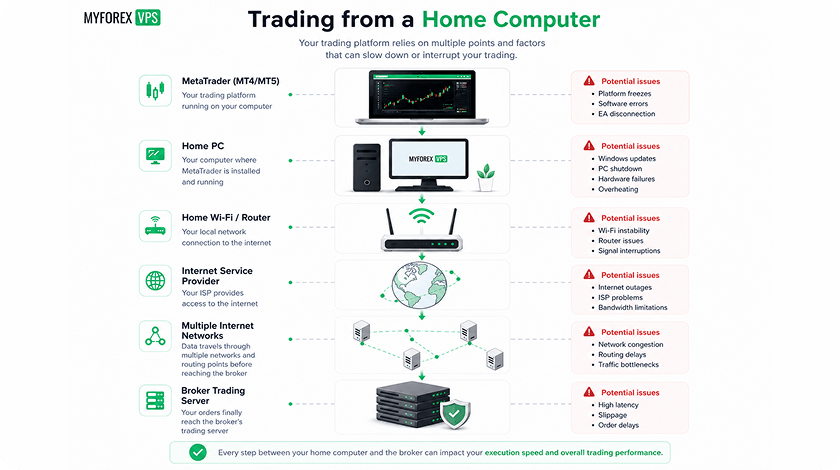
However, one of the most overlooked aspects of algorithmic trading is infrastructure.
A profitable strategy can become unprofitable if:
- Orders are delayed.
- Internet connections fail.
- Trading platforms disconnect.
- Computers crash.
- Power outages occur.
These issues may seem minor, but over hundreds or thousands of trades, they can significantly impact performance.
Professional traders understand that execution quality is part of the strategy itself.
Why Forex VPS Hosting Is Essential for Algorithmic Trading
Forex VPS hosting provides a dedicated cloud environment specifically designed for automated trading systems.
Instead of running Expert Advisors on a personal computer, traders deploy their systems inside professional data centers.
The advantages are substantial.
24/7 Uptime
Markets never stop moving.
A VPS allows trading systems to remain active continuously, regardless of whether the trader’s local computer is running.
Lower Latency
The closer a trading platform is to a broker’s execution servers, the faster orders can be processed.
Reduced latency can improve:
- Fill quality
- Slippage control
- Execution consistency
Improved Stability
Professional data centers provide:
- Redundant power systems
- Enterprise-grade networking
- Hardware monitoring
This significantly reduces operational risk.
Scalability
A VPS allows traders to run:
- Multiple Expert Advisors
- Multiple accounts
- Multiple trading terminals
from a single environment.
For serious algorithmic traders, VPS infrastructure has become a standard component of modern trading operations.
Common Mistakes in Algorithmic Forex Trading
Even experienced traders make mistakes when developing automated systems.
The most common include:
Overfitting
Creating a strategy that performs perfectly on historical data but fails in live markets.
Ignoring Transaction Costs
Spreads, commissions, and slippage can dramatically impact profitability.
Insufficient Risk Controls
Many promising algorithms fail because traders underestimate drawdown risk.
Lack of Monitoring
Automation does not eliminate the need for oversight.
Markets evolve, and strategies must adapt.
Poor Infrastructure
Even profitable systems can fail if execution quality is unreliable.
Risk Management for Algorithmic Trading
Risk management remains the foundation of long-term trading success.
Key principles include:
- Limiting risk per trade
- Diversifying across strategies
- Using stop-loss protection
- Monitoring drawdown
- Evaluating the correlation between positions
The objective is not simply maximizing returns.
The objective is to preserve capital while maintaining consistent performance.
The Future of Algorithmic Forex Trading
The next generation of Forex automation will likely be defined by:
- Artificial Intelligence
- Machine Learning
- Alternative Data Sources
- Cloud Computing
- Real-Time Analytics
As technology becomes increasingly accessible, retail traders will gain access to capabilities that were once available only to large financial institutions.
However, the fundamental principles will remain unchanged.
Successful trading algorithms will continue to rely on:
- Sound strategy design
- Effective risk management
- Reliable execution
- Robust infrastructure
Technology can enhance an edge, but it cannot create one where none exists.
Conclusion
Algorithmic Forex trading has transformed from a niche discipline into a central component of modern currency markets. What began as a tool used primarily by institutions is now accessible to individual traders, allowing them to automate strategies, improve consistency, and participate in the market with greater efficiency.
Whether traders are deploying a simple moving average crossover system, a sophisticated machine-learning model, or a portfolio of Expert Advisors, the same reality applies: success depends on far more than entry signals alone.
Profitable algorithmic trading requires robust strategy development, disciplined risk management, continuous testing, and reliable infrastructure.
As competition in the Forex market continues to increase, traders who combine intelligent automation with low-latency execution environments will be better positioned to adapt, scale, and maintain consistent performance over the long term.
For many serious traders, that journey begins with a reliable Forex VPS capable of delivering the stability, speed, and uptime that modern algorithmic trading demands.
FAQ
What is algorithmic Forex trading?
Algorithmic Forex trading is the use of computer programs to analyze market conditions and execute trades automatically according to predefined rules. These rules may be based on technical indicators, price action, statistical models, or machine learning algorithms.
How does a Forex trading algorithm work?
A Forex trading algorithm collects market data, analyzes predefined conditions, generates trading signals, and executes orders automatically. Most systems also manage stop-losses, take-profit levels, and position sizing without manual intervention.
Is algorithmic trading profitable in Forex?
Algorithmic trading can be profitable when a strategy has a proven edge, proper risk management, and reliable execution. Profitability depends on market conditions, strategy quality, trading costs, and infrastructure rather than automation alone.
What is the difference between algorithmic trading and automated trading?
Automated trading refers to any system that executes trades automatically. Algorithmic trading goes further by using mathematical models, statistical analysis, or programmed decision-making logic to generate trading signals and manage positions.
Do I need programming skills for algorithmic Forex trading?
Not necessarily. Many traders use pre-built Expert Advisors (EAs) or automated trading systems. However, learning MQL4, MQL5, or Python provides greater flexibility for developing and optimizing custom trading algorithms.
What is the best platform for algorithmic Forex trading?
MetaTrader 4 and MetaTrader 5 remain the most popular platforms for retail algorithmic trading. Other popular solutions include cTrader, TradingView, and Python-based quantitative trading frameworks.
Can I use algorithmic trading on MT4?
Yes. MetaTrader 4 supports algorithmic trading through Expert Advisors (EAs) developed using the MQL4 programming language. Traders can create, test, and deploy automated strategies directly within the platform.