There’s a moment in trading that doesn’t feel dramatic at first, but quietly changes everything.
It usually comes after you’ve spent enough time in the charts. You’ve watched the same patterns repeat, entered similar trades, and made the same decisions again and again — sometimes correctly, sometimes not. And then a simple thought appears:
“What if this could run without me?”
That’s how most traders arrive at Expert Advisors.
Not through programming. Through repetition.
Where Automation Actually Begins
People often think expert advisor programming starts with code. It doesn’t.
It starts with frustration.
You miss entries. You exit too early. You hesitate when your system says act.
At some point, you realize the issue isn’t your strategy. It’s execution.
And that’s when you begin translating decisions into rules.

What Expert Advisor Programming Really Means
An Expert Advisor is not intelligence. It’s precision.
It doesn’t “understand” the market. It executes instructions — exactly as written, without hesitation or interpretation.
And that’s where things get uncomfortable.
Because most traders don’t realize how vague their strategies actually are until they try to code them.
“Enter on breakout” suddenly becomes:
- what defines a breakout
- how strong it needs to be
- when it becomes invalid
This is where programming improves your trading — it forces clarity.
How to Start Expert Advisor Programming in MQL4
This is the part most articles either overcomplicate or skip entirely.
In reality, getting started is simple.
Inside MetaTrader 4, you open MetaEditor.
You create a new Expert Advisor file.
And you’re given a basic structure.
At first glance, it looks technical. But the core is surprisingly small:
int OnInit()
{
  return(INIT_SUCCEEDED);
}

void OnTick()
{
  // your trading logic runs here
}
That’s it.
Every EA you will ever build lives inside this structure.
OnInit() runs once when the EA starts.
OnTick() runs every time price updates.
And this is where your entire strategy begins to live.
When a Strategy Becomes Code
Let’s take something simple — a moving average crossover.
On a chart, it feels obvious. But in MQL4, even that idea needs structure.
At some point, your EA needs to define the market numerically:
double fastMA = iMA(NULL, 0, 50, 0, MODE_EMA, PRICE_CLOSE, 0);
double slowMA = iMA(NULL, 0, 200, 0, MODE_EMA, PRICE_CLOSE, 0);
You’re no longer “seeing” a crossover.
You’re calculating it.
And then comes the decision:
if (fastMA > slowMA && OrdersTotal() == 0)
{
  OrderSend(Symbol(), OP_BUY, 0.1, Ask, 3, 0, 0, "EMA Buy", 0, 0, clrGreen);
}
Simple logic. Clear rule. No hesitation.
The Detail That Changes Everything
What most beginners don’t realize is that this logic runs continuously — on every tick.
Not once per candle. Not at clean intervals.
Constantly.
Which means your EA reacts to noise, not just structure.
This is why experienced traders rarely trust raw signals.
They slow things down.
For example, using previous candle data:
double fastPrev = iMA(NULL, 0, 50, 0, MODE_EMA, PRICE_CLOSE, 1);
double slowPrev = iMA(NULL, 0, 200, 0, MODE_EMA, PRICE_CLOSE, 1);

if (fastPrev < slowPrev && fastMA > slowMA)
{
  // confirmed crossover
}
That one adjustment filters out a surprising amount of false entries.
Why Most EAs Fail in Live Trading
There’s a phase every EA trader goes through.
Your backtests look great. Smooth curve. Stable growth.
Then you go live.
And something feels… off.
Entries are slightly different. Exits don’t match expectations. Results drift.
Nothing is broken. But everything is less precise.
That’s when you realize:
Backrests assume perfect conditions.
Live markets don’t.

The Part Code Doesn’t Control
When your EA sends an order, it looks like this:
OrderSend(Symbol(), OP_BUY, 0.1, Ask, 3, 0, 0, "EA Trade", 0, 0, clrBlue);
But between this line and execution:
- price moves
- spread changes
- latency introduces delay
And none of that exists in your code.
This is why two identical EAs can produce different results.
A Small Adjustment That Makes a Big Difference
Experienced traders don’t assume perfect execution.
They design around imperfection.
For example, checking spread before trading:
double spread = (Ask - Bid) / Point;
if (spread < 20)
{
  // safe to execute trade
}
It’s not about optimization.
It’s about realism.
Why Running an EA on a VPS Changes the Game
At some point, every EA trader notices inconsistencies they can’t explain.
The code is the same. The broker is the same.
So what changed?
The environment.
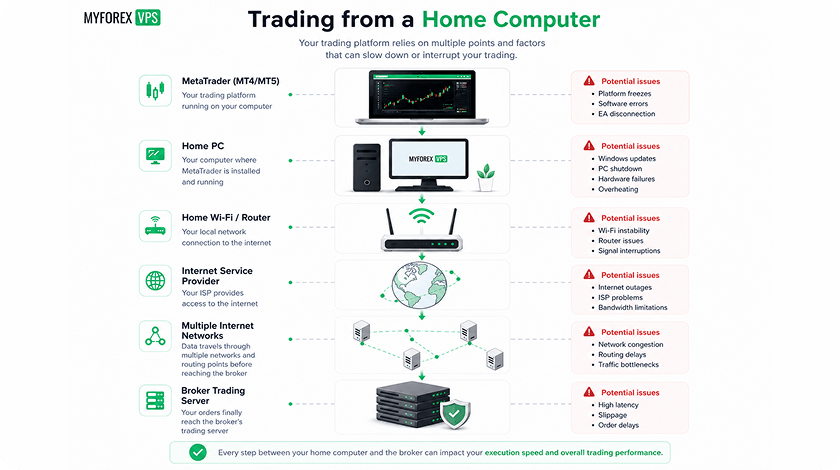
Running your EA on a local machine introduces:
- unstable connection
- platform interruptions
- inconsistent latency
A VPS removes those variables.
Your EA runs continuously.
Closer to your broker.
With stable execution timing.
And over time, that consistency becomes measurable.
From Beginner to Advanced: What Actually Changes
At the beginning, you focus on making your EA work.
Then you focus on making it profitable.
But real progress happens when you focus on making it reliable.
That means:
- fewer assumptions
- more tolerance
- better handling of imperfect conditions
This is where most traders stop evolving — and where advanced traders begin.
The Misconception About Automation
Automation doesn’t make trading easier.
It makes it more honest.
Every flaw in your logic becomes systematic.
Every weakness gets repeated.
An EA doesn’t fix your strategy.
It exposes it.
Final Thoughts
Expert advisor programming in MQL4 is not about writing complex code.
It’s about translating your trading logic into something precise, testable, and repeatable.
The code is just the tool.
What matters is how your system behaves when conditions are no longer ideal — when execution isn’t perfect, when latency exists, when the market doesn’t cooperate.
Because in the end, profitable automation isn’t built on perfect entries.
It’s built on systems that survive reality.