Most forex traders go through the same cycle.
A strategy stops performing, and the search begins again. New indicators, different settings, another EA, another YouTube video promising better entries or “institutional logic”. After every losing streak, it feels like something inside the strategy must be broken.
And sometimes that’s true.
But after looking at enough live trading accounts over the years, another pattern becomes hard to ignore.
Two traders can run almost identical setups — same currency pair, same risk, same entries, even the same version of MetaTrader 5 — and still end up with completely different results.
One account stays stable.
The other slowly starts leaking performance through worse fills, inconsistent execution, random slippage, and trades that somehow never look the same as they did in testing.
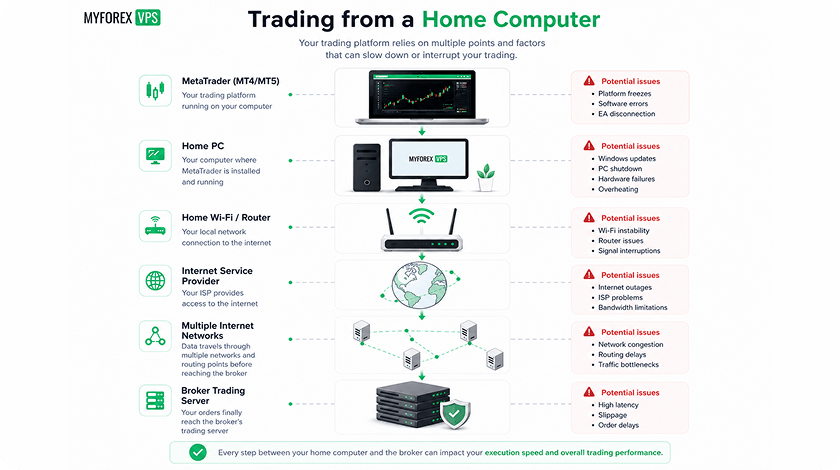
What makes this even more frustrating is that most traders don’t immediately connect the problem to infrastructure. They blame the strategy first, while the real issue may sit much lower in the stack: broker execution quality, latency, or the environment the system runs on. This is exactly why professional traders pay so much attention to execution conditions, low-latency setups, and properly configured forex VPS environments — because once you automate trading or rely on precision entries, the way an order reaches the market becomes just as important as the strategy itself.
But very often, the issue sits much lower in the stack.
Not in the strategy.
In the execution.
The Part of Trading Most People Never See
Retail forex platforms create the illusion that trading is instant.
You click Buy. The order appears. Position opened.
Simple.
But between the moment you send an order and the moment it actually reaches the market, an entire infrastructure layer comes into play. And that layer has far more influence over performance than most traders realize.
Orders are routed. Matched. Processed. Delayed. Requoted. Sometimes partially filled. Sometimes executed at prices that no longer exist by the time the request reaches the broker’s server.
This happens in milliseconds, which is exactly why most people ignore it.
They can’t see it happening.
But their results can.
Why the Same Strategy Produces Different Results
This is one of the strangest experiences for developing traders.
A strategy performs well on one account, then underperforms somewhere else. Same settings. Same conditions. Different outcome.
The instinct is usually to blame the strategy itself.
In reality, execution differences between brokers are often large enough to completely reshape performance.
Some brokers process orders internally before routing them externally. Others aggregate liquidity differently. Some maintain tighter execution during volatile periods, while others widen spreads aggressively or delay fills when markets move quickly.
These differences rarely matter for long-term swing positions. But the shorter the time horizon becomes, the more execution quality starts to dominate results.
A scalping strategy targeting three or four pips does not have much room for inefficiency. One slightly delayed entry or one widened spread can remove the entire edge.
And once that happens consistently, the system no longer behaves like the version you originally tested.
Backtests Hide the Most Important Variable
This is one of the reasons backtests create such misleading confidence.
Historical testing environments assume clean execution. They don’t realistically account for:
- fluctuating latency
- broker-side delays
- slippage during volatility
- spread expansion during news events
- execution queue congestion
The result is a version of the strategy operating under ideal conditions.
Live trading introduces friction.
And friction changes everything.
A system that appears highly profitable in testing can become unstable simply because the market conditions under which it executes are fundamentally different from the assumptions used during development.
This is why traders often describe the same experience in different words:
“It worked in demo.”
“The backtest looked amazing.”
“Results changed after going live.”
The strategy usually isn’t collapsing randomly.
The environment changed.
The Hidden Cost of Poor Execution
Most traders think execution problems look dramatic.
In reality, they’re usually subtle.
A slightly worse fill price.
A delayed entry during volatility.
A stop was executed a fraction later than expected.
A spread widening for two seconds during a news spike.
Individually, these seem insignificant.
But trading systems are built on statistical edges, and statistical edges are fragile. Once execution begins, introducing small inefficiencies repeatedly, profitability slowly erodes.
This is why some accounts don’t suddenly “blow up.” They decay.
The strategy still wins sometimes. The logic still appears valid. But over time, the numbers drift further and further away from what the trader originally expected.
And because the degradation happens gradually, most people never connect it to execution quality at all.
The Broker Matters More Than Most Traders Admit
Retail trading culture tends to obsess over strategy complexity while treating brokers as interchangeable.
They aren’t.
The quality of execution infrastructure behind a broker directly affects:
- slippage
- fill consistency
- spread behavior
- order routing
- latency sensitivity
This becomes even more important for traders using:
- scalping systems
- Expert Advisors in MetaTrader 4
- automated strategies in MetaTrader 5
- AI-based trading models
- news trading approaches
The faster the system operates, the more exposed it becomes to infrastructure inefficiencies.
And ironically, many traders respond to these problems by changing strategies instead of questioning execution quality.
A Real Example of Execution Drift
A trader develops a relatively simple automated EUR/USD strategy.
The system performs well during forward testing:
- stable entries
- controlled drawdown
- consistent risk profile
The trader then deploys it across two separate broker environments.
At first, the results remain close.
Then small differences begin appearing.
One account starts showing:
- slightly worse entries
- more slippage during volatility
- inconsistent exits around news releases
After several months, the performance gap becomes significant.
Not because the market changed.
Not because the strategy stopped working.
Because the execution conditions were no longer equivalent.
The strategy itself was stable.
The infrastructure around it was not.
Why VPS and Infrastructure Become Part of the Strategy
This is the point many traders resist at first.
They view infrastructure as something secondary. A convenience. An optimization.
But once execution becomes a meaningful variable, infrastructure stops being separate from the strategy itself.
Latency between your system and the broker server affects order timing. Connection stability affects whether positions are managed correctly during volatility. Physical proximity to trading servers affects consistency under fast market conditions.
A poorly configured environment introduces randomness into execution. And randomness is the enemy of systematic trading.
This is why professional setups prioritize stability long before complexity.
Not because infrastructure guarantees profitability.
But because unstable execution makes consistent profitability extremely difficult.
Most Traders Optimize the Wrong Layer
The retail trading industry encourages constant optimization.
New indicators. New systems. New AI models. New entry logic.
Very few traders are encouraged to examine the quality of execution itself.
And yet, execution is the layer through which every strategy interacts with the market.
If that layer is inconsistent, the strategy above it becomes difficult to evaluate objectively. A trader can spend months refining logic while unknowingly operating inside an unstable environment that continuously distorts results.
At that point, it becomes impossible to tell whether the strategy is flawed — or whether the conditions surrounding it are degrading performance.
Final Thought
Most traders believe their biggest edge comes from strategy.
In reality, many never get the chance to discover whether their strategy actually had an edge at all.
Because before the system reaches the market, it has to survive a chain of infrastructure decisions: broker quality, order routing, latency, server stability, and execution consistency.
That layer is invisible when things work normally. Which is exactly why it’s underestimated.
But over time, execution leaves fingerprints on every account.
Sometimes the difference between a profitable system and an unprofitable one is not intelligence, complexity, or optimization.
It’s simply whether the trade reached the market under the conditions the strategy expected.