Scalping is one of the most popular trading styles in the Forex market. The idea is simple: enter and exit trades within seconds or minutes, capture small price movements, and repeat the process dozens or even hundreds of times per day.
On paper, scalping looks like an efficient way to generate consistent profits. In reality, however, most retail traders fail when attempting to use forex scalping strategies. The reason is not always poor strategy design. In many cases, traders underestimate the technical requirements needed to execute scalping successfully.
Understanding why scalping fails can help traders avoid common mistakes and build a more reliable trading environment.
The Reality of Forex Scalping
Scalping depends on speed.
Unlike swing traders who target large market moves, scalpers often aim for profits of only a few pips per trade. When profit targets are small, execution quality becomes critically important.
A trade that is executed even a fraction of a second too late may result in:
- increased slippage
- worse entry prices
- missed opportunities
- reduced profitability
This means that successful scalping is not only about market analysis. It is also about infrastructure, connectivity, and execution speed.
Many retail traders focus entirely on indicators and entry signals while ignoring the technical side of trading. This is one of the primary reasons why scalping fails.

Poor Execution Destroys Scalping Performance
Many traders test a strategy on historical data and achieve promising results. However, once the strategy is traded live, performance often deteriorates.
The biggest difference is execution.
When a trade signal appears, the order must travel from the trader’s platform to the broker’s server. This process takes time. The delay may seem insignificant, but in fast-moving markets, even a few milliseconds can matter.
For example:
- A strategy targeting 3–5 pips per trade can lose a large percentage of expected profit due to execution delays.
- News-driven scalping strategies may become completely ineffective if orders arrive too late.
- High-frequency systems may generate signals faster than orders can be processed.
Retail traders often blame the strategy itself when the real issue is poor execution speed.
Forex Scalping Latency: The Hidden Cost
Latency refers to the time required for data and orders to travel between your trading platform and your broker.
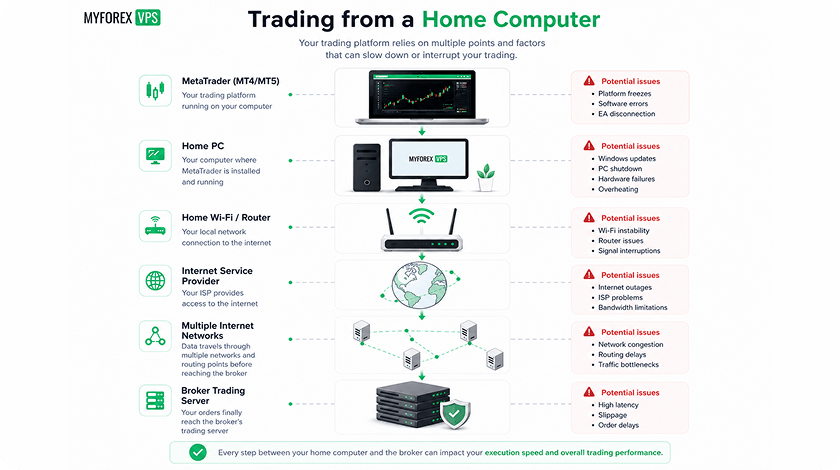
Many traders operate from home computers connected through residential internet networks. Depending on location, latency to a broker’s server may range from 50 ms to more than 200 ms.
For swing traders, this delay is usually irrelevant.
For scalpers, it can be devastating.
High forex scalping latency creates several problems:
Increased Slippage
When the market moves before your order reaches the broker, you receive a different price than expected.
Over hundreds of trades, small slippage costs accumulate into a significant performance drag.
Delayed Trade Entries
A profitable opportunity may disappear before your order is executed.
This is especially common during periods of high volatility.
Inconsistent Results
Backtests assume instant execution. Real-world latency introduces variables that can make live results differ dramatically from historical simulations.
Many traders spend months optimizing strategies while overlooking the latency issue that prevents those strategies from performing as expected.
Why Retail Traders Are at a Disadvantage
Institutional traders invest heavily in technology.
They use:
- dedicated servers
- professional data centers
- direct market connectivity
- optimized trading infrastructure
Retail traders often attempt to compete using a personal laptop connected through home Wi-Fi.
The difference is substantial.
Power outages, internet interruptions, operating system updates, and hardware limitations all introduce risk into the trading process.
For a scalper, even a brief disruption can result in missed trades or unexpected losses.
This technological disadvantage is one of the main reasons why most retail scalpers struggle to achieve consistent profitability.
Low Latency Trading Creates a Competitive Advantage
Professional traders understand that every millisecond matters.
Low latency trading reduces the time required for orders to reach broker servers, helping traders achieve faster and more accurate execution.
Benefits include:
- lower slippage
- improved fill quality
- more consistent execution
- faster reaction to market changes
- improved strategy performance
While low latency alone cannot guarantee profitability, it removes a significant obstacle that prevents many scalping systems from working efficiently.
The goal is not merely to trade faster than the market. The goal is to ensure that orders are executed as close as possible to the intended price.
Why a VPS Is Essential for Scalping
One of the most effective ways to improve execution speed is by using a VPS designed specifically for trading.
A Virtual Private Server allows traders to run their platforms continuously in a professional data center environment.
Instead of sending orders from a home computer hundreds or thousands of miles away from a broker, a VPS can be deployed close to the broker’s infrastructure.
This significantly reduces latency and improves execution quality.
A professional trading VPS offers:
- ultra-low latency connectivity
- 24/7 platform availability
- stable network performance
- uninterrupted operation
- reduced risk of hardware failures
For automated systems, these benefits are even more important.

The Best VPS for Scalping: What to Look For
Not all VPS solutions are suitable for scalping.
The best VPS for scalping should prioritize performance, stability, and proximity to major broker servers.
Key features to consider include:
Strategic Server Locations
Physical distance directly impacts latency.
Choose a provider with servers located near major financial data centers and broker infrastructure.
NVMe or SSD Storage
Fast storage improves platform responsiveness and reduces delays during intensive operations.
Dedicated Resources
Oversold VPS environments can lead to performance degradation.
Dedicated CPU and RAM allocations help maintain consistent execution speed.
High Uptime
Scalping systems require continuous availability.
Look for providers offering a 99.99% uptime guarantee.
Reliable Network Connectivity
Stable network performance is essential for maintaining low latency and avoiding interruptions during active market sessions.
Automated Scalping Requires Professional Infrastructure
Many modern forex scalping strategies rely on Expert Advisors, trading robots, and algorithmic systems.
These tools can react to market conditions faster than manual traders, but only if they operate in an optimized environment.
Running an automated strategy on a home computer introduces unnecessary risks:
- internet outages
- power failures
- software crashes
- connection instability
A low latency VPS helps ensure that trading systems remain active around the clock while maintaining consistent execution quality.
For algorithmic traders, infrastructure is not merely a convenience—it is a critical component of strategy performance.
Final Thoughts
Most retail traders believe that scalping fails because the market is too competitive or because profitable strategies no longer exist.
In reality, the problem is often much simpler.
Scalping is extremely sensitive to execution quality. Even a strong strategy can struggle when orders are delayed, slippage increases, or trading platforms experience interruptions.
Successful scalping requires more than technical analysis and trade signals. It requires professional-grade infrastructure capable of delivering fast, reliable, and consistent execution.
By reducing forex scalping latency, improving execution speed, and deploying a low latency trading VPS close to broker servers, traders can eliminate many of the obstacles that prevent scalping strategies from reaching their full potential