There’s a moment almost every trader reaches — usually not at the beginning, but somewhere in the middle of their journey.
Strategies are in place. Backtests look promising. The platform is stable. And yet, live results don’t quite match expectations.
Trades execute a fraction later than they should. Entries feel slightly “off.” Profits are there, but not as consistent as the model suggested.
At first, it’s easy to blame the market. Then the broker. Then the strategy itself.
But more often than traders expect, the real issue sits quietly in the background:
their infrastructure.
The Invisible Layer of Trading Performance
Forex trading is usually discussed in terms of strategy — indicators, price action, algorithms, risk management. Infrastructure rarely gets the same attention.
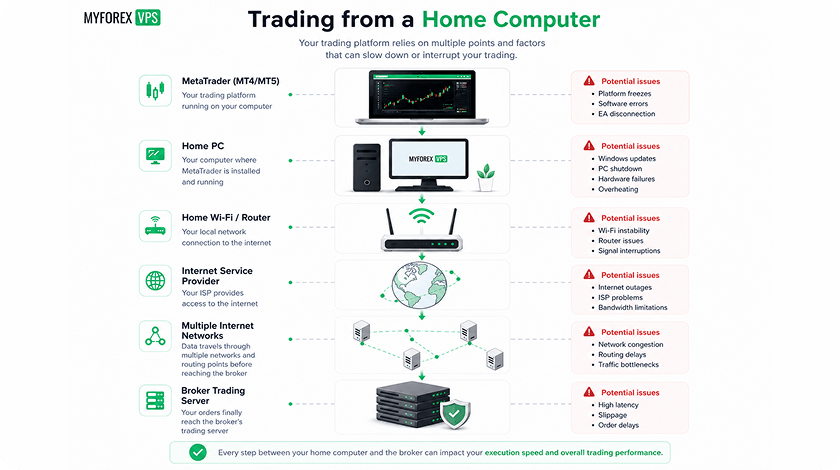
Yet every trade you place follows a path. It travels from your platform to your broker’s server, gets processed, matched, and executed. That journey takes time — sometimes milliseconds, sometimes longer.
And those milliseconds matter.
Not in theory, but in very practical ways: slippage, missed entries, partial fills. Small imperfections that don’t look dramatic on a single trade but accumulate over time.
This is where a Forex VPS enters the picture.
A VPS doesn’t change your strategy. It changes the environment where your strategy lives.
When “Good Enough” Is Actually Enough
For many traders, the first step into VPS hosting is a shared environment. It’s affordable, easy to set up, and immediately solves the most obvious problem: dependency on a personal computer.
No more worrying about power outages, unstable internet, or shutting down your platform overnight. The system runs continuously, exactly as intended.
And for a while, everything works.
If your trading style is relatively relaxed — perhaps a few trades per day, longer holding periods, minimal reliance on ultra-fast execution — a shared VPS can feel indistinguishable from a more advanced setup.
This is why it’s such a popular starting point. It removes friction without introducing complexity.
Where Subtle Problems Begin to Surface
The limitations of shared infrastructure rarely announce themselves loudly.
There is no clear “failure moment.” No error message saying something went wrong.
Instead, the symptoms are subtle.
A trade that enters slightly later than expected.
A take-profit that almost hits, but doesn’t.
A backtest curve that looks smoother than the live results.
Individually, these differences are easy to dismiss. Together, they begin to form a pattern.
What’s happening in the background is not dramatic — it’s simply competition for resources.
In a shared VPS environment, your trading platform exists alongside others. CPU cycles, memory, disk operations — all of these are distributed. Most of the time, this works perfectly fine.
But under load, especially during volatile market conditions, small delays can appear.
And in trading, “small” is often enough.

The Shift Toward Control
At some point, usually after enough unexplained inconsistencies, traders start looking deeper.
Not at indicators or settings, but at execution itself.
This is where dedicated VPS solutions enter the conversation.
The difference is not just technical — it’s conceptual.
With a dedicated VPS, you’re no longer sharing performance. The environment becomes predictable. Stable. Isolated.
Nothing else interferes with how your platform processes and sends orders.
And for the first time, many traders notice something unexpected:
not that execution becomes dramatically faster — but that it becomes consistent.
Why Consistency Changes Everything
Speed is easy to market. “Ultra-low latency” sounds impressive, and it matters.
But consistency is what actually shapes outcomes.
If one trade executes in 2 milliseconds and the next in 8, your strategy is no longer operating in a controlled environment. It’s adapting, reacting, compensating — often without you realizing it.
This is especially critical for systems that depend on precision.
Scalping strategies, for example, operate within extremely tight margins. A fraction of a pip can determine whether a trade is profitable or not.
Algorithmic systems rely on repeatability. They are built on the assumption that conditions remain stable.
When execution timing fluctuates, those assumptions break.
A dedicated VPS doesn’t eliminate market uncertainty — nothing can. But it removes one variable from the equation: your own infrastructure.
A Quiet but Meaningful Difference
Consider two traders running identical strategies.
Same broker. Same settings. Same market conditions.
One operates on a shared VPS. The other on a dedicated environment.
At first, their results look similar. Over time, small differences emerge.
The trader on dedicated infrastructure experiences fewer execution anomalies. Entries align more closely with intended levels. Slippage becomes less frequent, or at least more predictable.
There is no dramatic turning point — no single trade that explains the difference.
But over dozens, then hundreds of trades, the gap becomes visible.
Not because one strategy is better, but because one environment is more stable.
The Cost That Isn’t on the Invoice
One of the most persistent misconceptions in this space is that VPS decisions are primarily about price.
Shared solutions are cheaper. Dedicated ones cost more. The conclusion seems obvious.
But this way of thinking ignores how trading actually works.
You don’t pay for infrastructure only with money. You also “pay” through execution quality.
If your setup introduces even minor inefficiencies — slightly worse fills, occasional delays — those costs are absorbed into your results.
They don’t appear as a line item. They appear as reduced performance.
And unlike a subscription fee, they compound.
Choosing Based on Reality, Not Assumptions
So which one do you actually need?
The honest answer is less about the VPS itself and more about your trading behavior.
If your approach is measured, your frequency low, and your dependence on precise execution limited, a shared VPS can serve you well for a long time.
But if your strategy operates in tighter margins — if speed, timing, and consistency are not just advantages but requirements — then infrastructure stops being a convenience.
It becomes part of the system.
Where My Forex VPS Fits In
At My Forex VPS, this distinction is taken seriously.
Not every trader needs the same level of performance from day one. That’s why both shared and dedicated environments exist — not as competing products, but as stages.
A shared VPS can be a practical entry point, removing basic limitations and allowing strategies to run continuously.
A dedicated VPS, on the other hand, is where infrastructure begins to support performance at a deeper level — offering stability and predictability when they matter most.
The key is not choosing the “best” option in general, but the right one for where you are — and where your trading is going.
The Part Most Traders Overlook
There’s a tendency in trading to focus only on what is visible.
Charts, indicators, signals — the elements you can analyze and adjust.
Infrastructure sits outside of that. It’s not exciting. It doesn’t produce signals or generate entries.
But it defines how those signals are executed.
And over time, that distinction becomes impossible to ignore.
Because in trading, outcomes are not just about decisions.
They’re about how those decisions are delivered to the market.
Final Thought
A VPS will not turn a losing strategy into a profitable one.
But it will determine whether a good strategy performs as expected — or slowly drifts away from its potential.
Shared or dedicated is not just a technical choice.
It’s a decision about how much control you want over the final step of your trading process.
And in a market where small differences compound, that step matters more than it seems.