If you’re researching trading infrastructure, one of the most practical questions is:
How much does Forex VPS cost?
In 2026, Forex VPS pricing typically ranges between $8 and $60+ per month, depending on resource allocation, data center location, execution sensitivity, and service specialization.
However, understanding the cost requires more than reading a number. A VPS is not a performance booster — it is a risk-control tool. And pricing reflects the level of execution stability and infrastructure reliability you require.
If you’re new to VPS hosting, you may want to first review our detailed Forex VPS Hosting Guide 2026, which explains how trading servers actually work.

Typical Forex VPS Pricing in 2026
Here is a realistic pricing overview based on current market conditions:
| VPS Tier |
Monthly Cost |
Typical Use Case |
| Entry-Level VPS |
$8 – $15 |
1 MT4/MT5 terminal, basic automation |
| Standard Forex VPS |
$15 – $30 |
Multiple EAs, stable long-term operation |
| Low-Latency / Premium |
$30 – $60+ |
Scalping, news trading, latency-sensitive systems |
| Institutional Hosting |
$80 – $200+ |
Prop firms, capital managers |
Most retail traders operate comfortably within the $12–$25/month range.
What Determines Forex VPS Pricing?
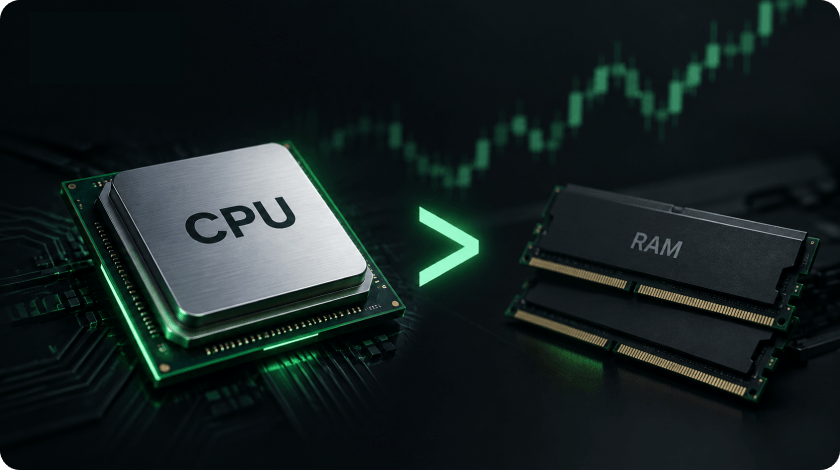
1 CPU and Memory Allocation
A single MT4 or MT5 terminal with 1–2 Expert Advisors typically requires:
If you run multiple terminals or complex EAs, resource demand increases. You can review practical examples in our guide on MT4 & MT5 VPS Requirements.
Higher allocated resources generally increase monthly cost — but excessive hardware rarely improves trading results.
2 Data Center Location and Latency
Forex VPS pricing varies significantly depending on physical server location.
Financial hubs such as:
often cost more due to proximity to broker infrastructure.
Lower latency environments are particularly important for scalping strategies. If you’re unsure whether latency matters for your system, see our detailed explanation of Low-Latency Forex VPS and Execution Impact.
For swing traders, uptime stability matters more than ultra-low latency.
3 Network Quality and Routing
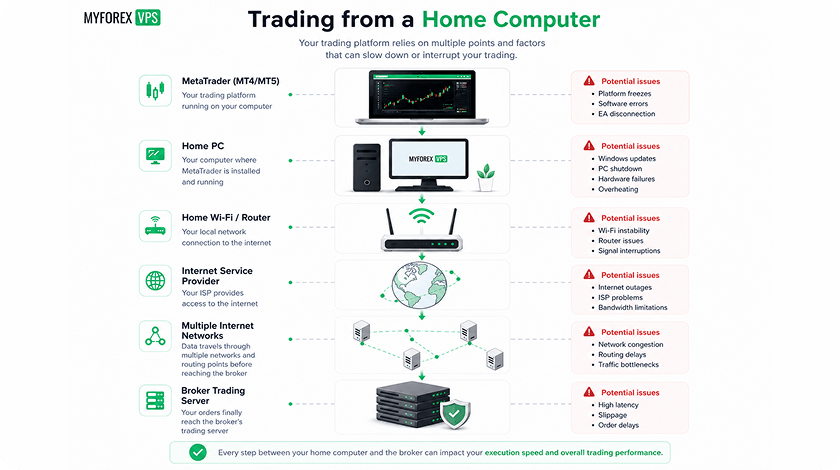
Latency is not just about milliseconds — it’s about routing stability. Premium VPS providers invest in optimized network paths and stable peering agreements.
Cheaper generic cloud servers may provide strong hardware but inconsistent routing performance.
Execution reliability depends more on network quality than on disk speed.
4 Forex-Specific Optimization
Some VPS providers offer:
- Pre-installed MT4/MT5 environments
- Automated restarts
- Broker proximity optimization
- Trading-focused server tuning
For example, Forex-oriented hosting services like My Forex VPS focus specifically on trading workloads rather than general-purpose cloud usage.
This specialization may slightly increase pricing compared to generic VPS providers — but it reduces configuration risk and operational friction.
Is Cheap Forex VPS Enough?
A common question:
Is $10 VPS enough for Forex trading?
For many traders — yes.
If you:
- Run 1 MT4/MT5 terminal
- Use 1–2 EAs
- Trade H1 or higher timeframes
- Do not scalp aggressively
A $10–$15 plan is usually sufficient.
However, cheap VPS plans may involve:
- Shared CPU performance
- Burst limitations
- Less consistent network routing
- Basic support response times
The risk is not failure — the risk is variability.
Why Do Some Forex VPS Plans Cost $40–$60?
At first glance, paying $40–$60 per month for a Forex VPS may seem excessive — especially when entry-level plans are available for $10–$15.
However, higher-tier VPS pricing reflects infrastructure designed for execution-sensitive trading environments, where milliseconds, uptime consistency, and resource isolation directly affect trade outcomes.
Let’s break down what you’re actually paying for.
Dedicated CPU Allocation (Not Shared Bursts)
Lower-cost VPS plans typically operate on shared CPU environments. This means your MT4/MT5 terminal shares processing power with other virtual machines on the same physical server.
Under normal conditions, this works fine.
But during high-load events — such as:
- Major economic releases (NFP, CPI, FOMC)
- High market volatility
- Peak trading sessions
CPU contention may occur.
Higher-tier plans often provide:
- Dedicated or reserved CPU cores
- Guaranteed processing allocation
- No resource throttling under load
Example:
If you run 4 MT5 terminals with multiple EAs and one core becomes saturated during a news spike, shared CPU hosting may cause temporary execution delay. Dedicated allocation prevents this resource conflict.
For scalping systems targeting 2–5 pip moves, this difference is operationally significant.
Premium Financial Data Centers
Higher-tier VPS providers frequently host servers in financial-grade facilities such as:
- NY4 (New York)
- LD4 (London)
- Equinix data centers
- Broker-adjacent environments
These locations offer:
- Direct peering with liquidity providers
- Reduced network hops
- More stable cross-connect infrastructure
This does not mean “faster profits.”
It means more predictable execution routing.
For example, a standard cloud VPS might show 15–25 ms latency to your broker.
A premium data center location may reduce this to 1–5 ms.
For swing traders, this difference is negligible.
For scalpers trading around spread compression, it can materially affect fill quality.
Advanced Routing Optimization
Latency is not just about speed — it is about consistency.
Premium VPS plans often include:
- Optimized network paths
- Tier-1 bandwidth providers
- Stable routing agreements
- Reduced packet loss
Cheaper VPS environments may show acceptable average latency but inconsistent routing during volatile conditions.
In real trading terms:
- 3 ms stable latency is better than 2–15 ms fluctuating latency.
- Execution consistency reduces slippage variability.
Professional traders focus more on stability than on theoretical lowest ping.
Higher Uptime Guarantees
Entry-level VPS plans typically offer:
Premium plans may offer:
- 99.99% uptime guarantees
- Redundant infrastructure
- Faster hardware failover
The difference between 99.9% and 99.99% uptime equals roughly:
- 8.7 hours downtime per year (99.9%)
- 52 minutes downtime per year (99.99%)
If your EA trades 24/5 and manages open positions overnight, this distinction matters.
Infrastructure downtime during high-volatility events can disrupt risk exposure and trade management logic.
Priority Technical Support
Lower-cost plans often provide:
- Ticket-based support
- 12–24 hour response times
Higher-tier plans may include:
- Faster response windows
- Trading-aware support teams
- Infrastructure-level diagnostics
For traders managing capital or funded accounts, response speed during server instability is part of operational risk management.
Who Actually Needs a $40–$60 Forex VPS?
These plans are typically used by:
Scalpers
Strategies targeting small pip gains where execution precision and latency consistency directly affect performance.
News Traders
Systems executing during macroeconomic releases, where server stability under load is critical.
Multi-Account Operators
Traders running:
- 5+ MT4/MT5 terminals
- Multiple funded accounts
- Portfolio-level risk management
Professional Capital Managers
Traders managing external funds or operating under prop firm evaluation rules, where uptime and execution consistency are part of compliance discipline.
When Is This Level Unnecessary?
For most retail traders:
- 1–2 terminals
- Moderate EA usage
- H1+ timeframes
- Non-scalping strategies
A stable $15–$25 VPS plan is usually sufficient.
Paying $50/month without execution-sensitive strategy requirements does not improve profitability. It only increases operating cost.
The Real Decision Framework
The correct question is not:
“Is $60 VPS better?”
The correct question is:
“Does my strategy materially depend on latency stability, resource isolation, and infrastructure redundancy?”
If the answer is yes — premium hosting becomes part of risk control.
If not — mid-tier infrastructure provides adequate reliability without unnecessary cost escalation.
Does a More Expensive VPS Improve Trading Results?
This is where EEAT and financial responsibility matter.
A VPS does not improve:
- Strategy edge
- Risk management discipline
- Market timing
- Psychological control
A VPS improves:
- Uptime stability
- Execution consistency
- Reduced disconnections
- Lower operational risk
The purpose of a VPS is not to increase profitability — it is to reduce avoidable technical risk.
That distinction is critical.
Annual Cost Perspective
If you use a $15/month VPS:
$15 × 12 = $180 per year
Compared to potential slippage, missed trades, or overnight disconnects, infrastructure cost is relatively small in proportion to trading capital.
Professional traders treat infrastructure as part of their operating expense — not as optional overhead.
How Much Should You Spend on Forex VPS?
A practical guideline:
- Beginner / 1 EA → $10–$15/month
- Multiple terminals → $20–$30/month
- Latency-sensitive strategies → $30+/month
Overspending does not increase profitability.
Underspending may increase operational risk.
The goal is balance.
Final Takeaway
The average Forex VPS cost in 2026 is modest. Most traders spend $12–$20 per month.
The important question is not “What is the cheapest VPS?”
It is:
“What level of infrastructure reliability does my strategy require?”
If you’re unsure, start with a balanced entry-level plan and scale only when your trading volume or execution sensitivity justifies it.
Infrastructure should support your strategy — not become your strategy.
FAQ
How much does Forex VPS cost per month?
In 2026, most Forex VPS plans cost between $8 and $30 per month for retail traders. Premium low-latency solutions may exceed $40 per month.
Are Forex VPS prices different from regular VPS?
Yes. Forex VPS services are often optimized for trading workloads, broker proximity, and latency stability. Generic cloud VPS plans may be cheaper but require manual configuration.
Is the cheapest Forex VPS safe to use?
Cheap VPS plans are safe if used within their resource limits. However, performance variability may occur under shared CPU conditions. Traders running sensitive strategies should consider mid-tier plans.
Does paying more guarantee better execution?
Not necessarily. Execution quality depends on broker infrastructure, market liquidity, and routing stability — not just VPS price. Higher-tier VPS plans reduce operational risk but do not guarantee trading profitability.