In 2026, the phrase “AI forex trading” has quietly shifted from niche curiosity to mainstream obsession.
Search volumes around terms like ai robot forex trading, ai based forex trading, and best forex trading AI are climbing — not because the technology suddenly cracked the market, but because access became dangerously easy.
Today, anyone can spin up what looks like a sophisticated system:
- download an AI forex trading software
- plug it into MetaTrader 5
- run it on historical data
- and generate an equity curve that feels… convincing
For a moment, it looks like the problem is solved.
But spend enough time behind the scenes — not in marketing pages, not in “AI forex trading software reviews,” but in actual live environments — and a different pattern starts to emerge.
The issue is rarely the model itself.
It’s not that these systems are “dumb,” broken, or badly coded.
It’s that they’re operating in conditions they were never designed for.
Because in real forex trading:
- prices are not clean
- execution is not instant
- latency is not constant
- and the market does not behave like your dataset
And this is the uncomfortable gap most discussions avoid:
AI trading systems are built in controlled environments —
but deployed into unstable, adversarial ones.
That mismatch is where performance quietly disappears.
And it’s also why so many AI-powered forex trading software solutions — especially the ones heavily promoted online — look impressive in theory, but fail the moment they go live.
This is the part almost no one explains.
The Illusion of Intelligence (Why Models Look Better Than They Are)
On paper, AI looks unbeatable.
You feed it years of historical data, it detects patterns, optimizes entries, filters noise — and suddenly you have a strategy with a beautiful equity curve.
But here’s the uncomfortable reality:
Financial data is not stationary.
That means:
- relationships between variables constantly change
- volatility regimes shift
- liquidity conditions evolve
So what your model learns is often:
“What worked in a specific market regime — not what will work next.”
What this looks like in practice:
A model trained on 2020–2022 data:
- performs great in trending conditions
- collapses in sideways or news-driven markets
And because AI optimizes aggressively, it often overfits these regimes invisibly.
You don’t see it until it’s too late.
Where Most AI Trading Systems Actually Break
Let’s go deeper than surface-level explanations.
Failures usually happen not in one place — but across layers.
1. Data: The Problem No One Wants to Talk About
Retail traders rarely have access to:
- true tick-level institutional data
- order book depth
- real execution flow
Instead, they use:
- broker-exported candles
- inconsistent tick histories
- aggregated feeds
This creates a distorted reality.
Your AI model is learning from:
- smoothed prices
- missing microstructure
- artificial spreads
So it builds logic that cannot survive real execution conditions.
2. Execution: Where Theory Meets the Market
Most AI discussions completely ignore execution mechanics.
But in real trading:
Entry price ≠ expected price
Even small differences matter.
Let’s say your model:
- targets 3–5 pip scalps
- relies on precise entries
Now add:
- 1.5 pip spread
- 1 pip slippage
- 80 ms delay
Suddenly:
Your edge is gone before the trade even starts.
3. Latency: The Silent Strategy Killer
Latency isn’t just a “technical metric.”
It directly affects:
- fill quality
- order timing
- slippage
Real impact:
- 5 ms → near-instant execution
- 80 ms → delayed reaction
- 150 ms → missed opportunity
For AI systems (which react instantly), this mismatch is critical.
The model reacts in microseconds.
Your infrastructure reacts in milliseconds.
That gap is where performance disappears.
4. Environment Instability
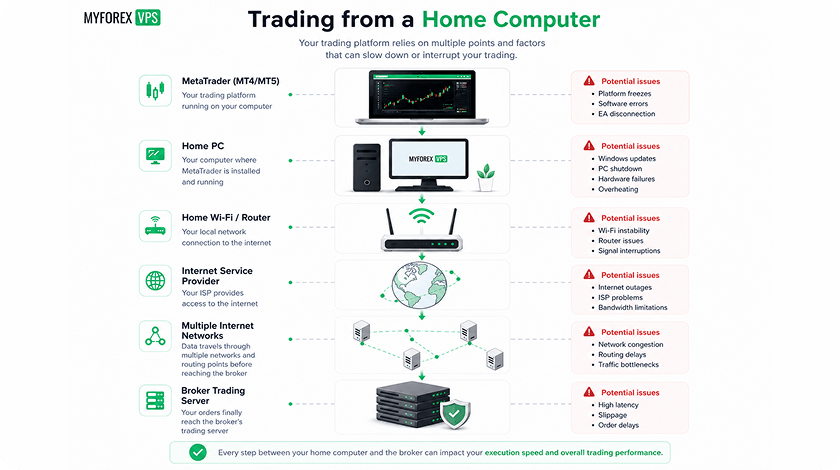
Running AI trading systems on a home setup introduces randomness:
- Windows updates during trading
- Wi-Fi drops
- CPU throttling
- background processes
Each of these can:
- delay execution
- interrupt strategies
- corrupt results
And the worst part:
These failures are inconsistent — which makes them hard to diagnose.

Real Case: How Latency Killed a Profitable AI Strategy
Let’s break down a real-world scenario.
A trader built an AI-based scalping model:
- trained on EUR/USD tick data
- average target: 4–6 pips
- win rate: ~63% in forward testing
Setup:
- Python model + execution via MetaTrader 5
- Running on a home PC (London)
- Broker server in LD4
Expected:
- stable execution
- consistent fills
What actually happened:
During live trading:
- latency fluctuated between 40–120 ms
- occasional spikes to 200+ ms
- slippage increased during volatility
Result after 3 weeks:
- win rate dropped from 63% → 48%
- average profit per trade decreased
- drawdown increased significantly
Root cause (after analysis):
Not the model.
Not the strategy.
Execution inconsistency due to latency variance
What changed after moving to VPS:
Trader switched to a VPS near LD4:
- latency stabilized at 2–4 ms
- slippage reduced
- execution timing normalized
New results:
- win rate recovered to ~60%
- equity curve stabilized
- drawdown reduced
Key insight:
The strategy didn’t improve.
The environment stopped degrading it.
Why VPS Becomes Critical With AI (Not Optional)
AI systems amplify both:
When execution is unstable:
losses scale faster
A properly configured forex VPS removes key variables:
✔ Stable latency
Consistent execution timing
✔ 24/7 uptime
No interruptions during market sessions
✔ Proximity to broker
Reduced slippage and faster fills
AI vs EAs: What Professionals Actually Do
There’s a misconception that traders are “switching” from EAs to AI.
In reality, advanced setups look like this:
AI layer:
- generates signals
- adapts to patterns
EA layer:
- executes trades
- manages risk
- ensures consistency
This hybrid approach solves a key issue:
- AI is flexible but unstable
- EAs are stable but rigid
Together, they balance each other.
Why “AI Forex Trading Software” Often Disappoints
If you look closely at most AI forex trading software, the pattern is hard to miss. The presentation is polished, the language is confident, and the results look almost слишком аккуратно: smooth equity curves, stable growth, high win rates. In categories like best forex trading AI or ai powered forex trading software, many tools seem interchangeable — all promising adaptive logic and “self-learning” capabilities. But what sits behind these results is rarely explained. There’s almost no context around execution: what latency the system assumes, how it behaves under slippage, what kind of infrastructure was used during testing. And that omission matters more than the strategy itself, because in real trading environments — whether through MetaTrader 4 or MetaTrader 5 — every trade is affected by delays, spread changes, and imperfect fills.
That’s why the same experience keeps repeating, regardless of the specific ai software for forex trading someone chooses. A system that looks stable in demo or backtest starts to degrade once it goes live, not because the logic suddenly stops working, but because the conditions have changed. Backtests assume precision; live markets introduce friction. Even small differences — a few milliseconds of latency, a slight increase in spread — are enough to shift performance, especially for strategies that depend on timing. This is where most expectations break: traders evaluate systems in ideal conditions, then deploy them in environments that don’t match those assumptions. And the result is predictable — what looked like a reliable AI trading solution begins to drift, then underperform, and eventually gets written off as “not working,” when in reality it was never tested under the conditions it actually needed to survive.
What a Real AI Trading Stack Looks Like in 2026
Strip away the hype, and you get something much more pragmatic:
1. Model (simple, robust)
Not over-optimized. Designed to survive regime changes.
2. Data (clean, consistent)
Even if limited — but reliable.
3. Execution (controlled)
Low latency, predictable environment.
4. Infrastructure (VPS)
This is the backbone — not an add-on.
The Uncomfortable Truth About AI Trading
AI doesn’t remove uncertainty.
It compresses it.
- Faster decisions
- More trades
- Quicker feedback loops
Which means:
Mistakes become more expensive, faster.
Final Thought
The conversation around AI in forex trading is still focused on the wrong layer.
Most discussions — whether in ai forex trading reddit threads or “best forex trading AI” roundups — revolve around the same questions:
Which model is better?
Which bot is profitable?
Which AI software delivers the highest returns?
But in practice, that’s not how experienced traders think.
The real question sounds much less exciting — and far more important:
Can this system actually survive real execution conditions?
Because that’s where most strategies quietly fall apart. Not in theory, not in backtests — but in the messy reality of live markets, where latency fluctuates, spreads widen, and execution is never perfect.
From our experience, the difference between a system that looks good and one that actually works is rarely the algorithm itself. It’s whether the entire setup — from infrastructure to execution — supports the assumptions behind it.
But that’s just our perspective.
If you’ve tested any AI-based forex trading systems, we’d be genuinely interested to hear how they performed for you in live conditions. Did your results match expectations — or did things change once real execution came into play?
Key Takeaways
- AI models often fail due to changing market regimes
- Data quality is a major hidden limitation
- Execution (latency, slippage) defines real performance
- VPS is essential for stability, not convenience
- Hybrid systems outperform pure AI approaches
- Infrastructure is often the real edge