There’s a quiet detail in Forex trading that rarely makes it into strategy discussions, yet it quietly shapes execution quality every single day: server location.
You can have a robust trading system, disciplined risk management, and stable capital allocation. But if your trading platform is physically far from your broker’s execution servers, you introduce a layer of invisible friction.
That friction has a name: latency.
And the solution often begins with three cryptic codes traders frequently encounter: NY4, LD4, and Frankfurt.
This is not marketing jargon. These are real financial data centers. And proximity to them can influence how your trades are executed.
Let’s unpack why.

What Are NY4 and LD4?
NY4 and LD4 are high-performance financial data centers operated by Equinix.
- NY4 is located in Secaucus, New Jersey — a major hub for U.S. liquidity providers and brokers.
- LD4 is located in Slough, near London — one of Europe’s primary financial connectivity hubs.
Many large Forex brokers, liquidity providers, and prime brokers colocate their servers inside or near these facilities. When traders say “choose NY4,” what they really mean is:
Place your VPS as close as possible to your broker’s execution engine.
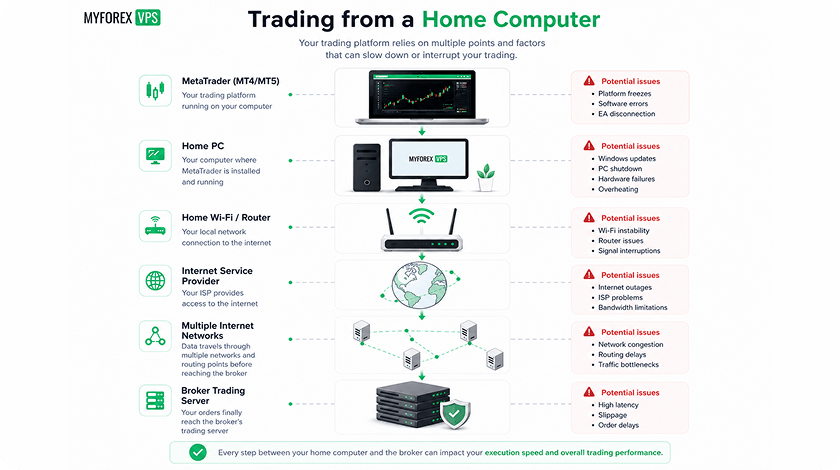
Physical proximity reduces the number of network hops between your platform and the broker.
In digital infrastructure, distance still matters.
Why Physical Proximity Affects Execution
A trade order travels through physical cables and network routes. Even in 2026, data does not teleport.
Here’s what typically happens when you click “Buy” on MT4 or MT5:
- Your terminal sends the order to your VPS (if hosted remotely).
- The VPS transmits it through the network.
- It reaches your broker’s server.
- The broker routes it to liquidity providers.
- The execution confirmation travels back.
Every additional kilometer adds transmission time. Every additional routing node adds variability.
Typical Latency Examples
| Setup |
Approximate Latency |
| Home Wi-Fi → Broker |
80–200 ms |
| Generic cloud VPS |
20–40 ms |
| VPS in NY4 / LD4 |
1–5 ms |
For swing traders operating on H4 or D1 timeframes, a 30 ms difference is irrelevant.
For scalpers targeting 1–3 pips, that same delay can alter fill quality.
Latency alone does not determine success. But latency variability — jitter — can introduce unpredictable execution results.
It’s Not Just Speed. It’s Stability.
One of the most misunderstood aspects of Forex VPS locations is the obsession with raw ping numbers.
Traders often chase “1 ms” marketing claims.
But execution stability depends more on:
- Consistent routing
- Low packet loss
- Minimal jitter
- Reliable peering agreements
A stable 6 ms connection is often superior to a fluctuating 2–25 ms connection.
Premium data centers such as NY4 and LD4 host financial institutions that invest heavily in network redundancy and routing optimization. This reduces the likelihood of unexpected spikes during volatile market conditions.
In trading, predictability matters more than theoretical speed.
When Location Truly Matters
Not every trader needs proximity to NY4 or LD4.
Let’s be precise.
Location is critical for:
- High-frequency scalping systems
- News trading strategies
- Latency arbitrage models
- Multi-account copy trading setups
In these scenarios, milliseconds directly affect entry price and slippage.
Location is less important for:
- Swing traders
- Position traders
- Manual discretionary traders
- Strategies operating on H1+ timeframes
For these traders, uptime reliability matters more than ultra-low latency.
Understanding your strategy’s sensitivity to execution speed is key before investing in premium locations.
The Hidden Factor: Broker Infrastructure
A crucial detail often overlooked: your VPS should be close to your broker’s server, not just a famous data center.
Some brokers host in:
- NY4
- LD4
- Frankfurt
- Amsterdam
- Tokyo
Choosing NY4 only helps if your broker’s trade server is in or near NY4.
Professional traders confirm broker server location before selecting a VPS region.
Proximity without alignment is meaningless.
Does Proximity Guarantee Better Trading Results?
No.
It reduces one category of operational risk: execution delay.
It does not improve:
- Strategy logic
- Risk management
- Market timing
- Discipline
A well-located VPS is infrastructure optimization — not a profitability engine.
The goal is not to eliminate latency entirely.
The goal is to eliminate unnecessary execution variability.
NY4 vs LD4: Which Should You Choose?
The answer depends on:
- Your broker’s server location
- The liquidity pool your broker connects to
- Your primary trading sessions
If you trade:
- U.S. sessions → NY4 proximity may be logical
- London session pairs (EUR, GBP) → LD4 proximity may align better
But again, broker location is the deciding factor.
The Cost of Being Far Away
Let’s consider a practical example.
A scalping EA targets 2 pips average profit.
Average slippage increases by 0.5 pips due to routing delay.
Over 500 trades:
0.5 pips × 500 = 250 pips impact.
Even modest latency-related slippage compounds over time.
For a swing trader targeting 100+ pip moves?
This impact becomes statistically insignificant.
Infrastructure decisions must match strategy design.
Frankfurt, Amsterdam, and Other Emerging Hubs
While NY4 and LD4 are dominant, European traders often encounter:
- Frankfurt financial data centers
- Amsterdam connectivity hubs
These locations serve brokers focused on EU liquidity pools.
Again, proximity matters — but alignment matters more.
Professional Perspective: Infrastructure as Risk Control
Serious traders treat VPS location as part of their operational framework.
Not because they are chasing milliseconds.
But because they are reducing avoidable friction.
Execution risk is one of the few controllable external factors in trading.
You cannot control volatility.
You cannot control macroeconomic releases.
You can control where your trading engine runs.
Final Takeaway
NY4 and LD4 are not magic codes. They are financial infrastructure hubs.
Proximity matters when:
- Your strategy is execution-sensitive
- Your edge depends on tight spreads and rapid fills
- You operate multiple accounts
- You manage external capital
For many retail traders, stable mid-tier hosting is sufficient.
For latency-sensitive systems, choosing the correct VPS location is not an upgrade — it is a structural decision.
In trading, small frictions compound.
So do small optimizations.
And server location is one of the few optimizations fully within your control.
Frequently Asked Questions
What is NY4 in Forex trading?
NY4 is a financial data center located in Secaucus, New Jersey, operated by Equinix. Many Forex brokers and liquidity providers host their servers there. Using a VPS near NY4 can reduce latency if your broker’s trading server is also located in or near that facility.
What does LD4 mean in Forex VPS hosting?
LD4 refers to a financial data center in Slough, near London. It is one of Europe’s main trading infrastructure hubs. A VPS hosted in LD4 may provide lower latency for brokers connected to London-based liquidity pools.
Does VPS location really matter for Forex trading?
Yes, but only for certain strategies. VPS location matters most for scalping, news trading, and latency-sensitive systems. For swing or position traders, server stability and uptime are more important than ultra-low latency.
How much latency difference does NY4 vs home internet make?
Home internet connections often range between 80–200 milliseconds. A VPS located in the same data center as your broker may reduce latency to 1–5 milliseconds. However, execution consistency matters more than raw speed.
Should I always choose NY4 or LD4?
No. You should choose a VPS location based on your broker’s server location. If your broker hosts in Frankfurt or Amsterdam, selecting NY4 may not reduce latency.
Does lower latency guarantee better profits?
No. Lower latency reduces execution delay and slippage risk but does not improve strategy logic, risk management, or trading discipline.