Why Historical Profitability Is Often an Illusion
There is a moment almost every systematic trader experiences. The backtest looks exceptional – steady equity growth, manageable drawdowns, strong profit factor. The numbers feel convincing. The logic seems validated. Capital is deployed.
And then reality intervenes.
The same strategy that performed flawlessly in historical simulation begins to struggle in live conditions. Execution is slightly worse. Drawdowns feel deeper. Results drift away from the projected curve. The question appears almost immediately:
Are Forex backtests reliable – or are we trusting an illusion?
To answer that, we need to understand what backtesting measures actually do, what it silently ignores, and why forward testing often reveals truths that historical data cannot.
What a Backtest Really Shows – and What It Hides
A backtest is, at its core, a reconstruction. Trading platforms such as MetaTrader simulate how a strategy would have behaved under past market conditions using stored price data and predefined execution assumptions.
This process is valuable. It allows traders to:
- Detect logical flaws in strategy rules
- Estimate statistical expectancy
- Observe historical drawdown behavior
- Compare parameter variations
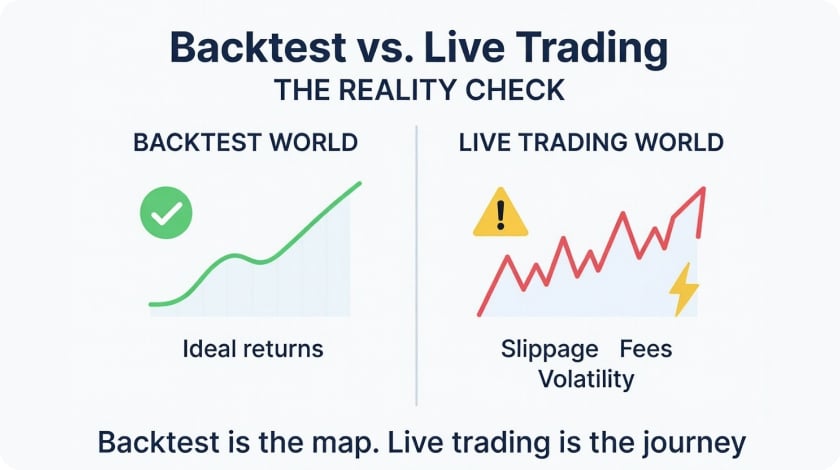
But a backtest operates inside a controlled laboratory. It assumes clean data, predictable spreads, and immediate execution at quoted prices. In other words, it evaluates mathematical logic, not market friction.
Live markets are not laboratories.
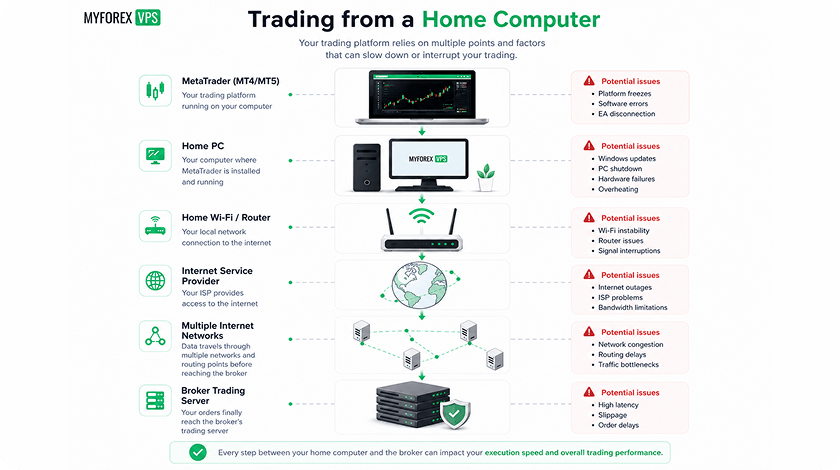
They involve routing delays, liquidity constraints, temporary spread explosions, order queue positioning, and infrastructure dependencies. None of these variables is fully represented in a historical simulation.
That gap is where illusion begins.
Why a Profitable Backtest Can Fail Live
The most uncomfortable truth in systematic trading is this: a strategy can be profitable for years in historical data and fail within weeks of live deployment.
The reasons are rarely mysterious – but they are often underestimated.
Over-Optimization
When parameters are tuned too precisely to historical data, the strategy adapts to past noise rather than structural market behavior. The equity curve becomes smooth not because the edge is robust, but because randomness has been shaped into a pattern.
As soon as market conditions shift, that fragile optimization collapses.
Execution Friction
Backtests often assume constant spreads. In live markets, spreads widen during volatility, narrow in calm conditions, and fluctuate unpredictably. For strategies that operate on small margins – especially scalping systems – even minor slippage changes the entire expectancy profile.
A backtest does not experience hesitation in order queues. A live account does.
Latency and Infrastructure Effects
In simulation, every order is executed under idealized assumptions. In reality, order routing depends on server proximity, network quality, broker architecture, and sometimes pure chance.
Two traders running the same Expert Advisor may see different results purely because their technical environments differ.
Psychological Interference
Even traders using automated systems are not immune to intervention. Early trade closures, manual pauses during drawdowns, risk reduction after losses – these human elements alter live results in ways no backtest anticipates.
The market tests more than logic. It tests discipline and infrastructure.
Does Forward Testing Work Better?
Forward testing does not replace backtesting. It exposes what backtesting cannot see.
When a strategy is run in real time – whether on demo or small live capital – it interacts with:
- Actual spreads
- Real slippage
- Dynamic liquidity
- Broker execution policies
- Server stability
Forward testing reveals operational weaknesses. It shows whether the strategy behaves consistently across changing volatility regimes. It surfaces execution sensitivity. It exposes whether the system degrades gradually or fails abruptly.
However, forward testing has its own limitations. It requires time. It may occur during unusually favorable conditions. Its statistical sample is often smaller than historical datasets.
The most reliable validation process integrates both approaches.
Backtest vs Forward Test: A Practical Comparison
| Factor |
Backtest |
Forward Test |
| Historical data scope |
Large |
Limited |
| Execution realism |
Simulated |
Real |
| Slippage & spread variability |
Assumed |
Actual |
| Infrastructure effects |
Ignored |
Included |
| Speed of feedback |
Immediate |
Slow |
| Psychological influence |
None |
Present |
The distinction is not about which method is superior. It is about recognizing what each method measures.
Backtesting asks:
Did this logic work under past data conditions?
Forward testing asks:
Can this logic survive real-time market friction?
Live trading ultimately asks:
Can the trader manage both risk and uncertainty consistently?
Why Live Trading Results Differ From Backtests
Markets evolve. Liquidity providers change. Volatility cycles shift. Structural characteristics of Forex today are not identical to those five years ago.
Historical data assumes stationarity. Markets are not stationary.
Spread regimes change. News events distort liquidity. Data modeling quality varies. Even tick reconstruction methods differ between brokers.
Two traders can run the same EA on the same currency pair and obtain slightly different historical reports – simply because of data feed differences. Multiply that variation in live conditions, and divergence becomes inevitable.
The smooth equity curve that once inspired confidence begins to reveal its fragility.
How Long Should You Forward Test?
There is no fixed rule, but meaningful validation typically requires:
- Several months of testing
- Exposure to multiple volatility conditions
- A statistically relevant number of trades
Testing a strategy for two weeks in calm markets proves little. A strategy must experience both favorable and adverse environments to demonstrate resilience.
Forward testing is not about confirming profitability. It is about confirming stability under stress.
The Illusion of Perfect Curves
Perhaps the most deceptive feature of backtests is visual smoothness. Traders are naturally drawn to clean upward curves with minimal drawdowns.
Yet markets are not smooth.
If a historical equity curve appears almost linear, it may indicate overfitting, insufficient transaction cost modeling, or unrealistic assumptions. Robust systems tend to look imperfect. They fluctuate. They adapt.
The absence of noise in a backtest is often a warning sign, not a strength.
Toward a More Realistic Validation Process
Professional traders treat strategy validation as layered verification:
- Historical backtesting across multiple market periods
- Walk-forward optimization
- Sensitivity testing under increased spread assumptions
- Real-time forward testing
- Gradual capital allocation
Each layer removes a different type of illusion.
Backtesting filters broken logic.
Forward testing filters operational weakness.
Live trading filters emotional inconsistency.
The goal is not to find perfection. It is to reduce uncertainty.
Final Perspective
Historical profitability is not evidence of future success. It is a hypothesis formed under simplified assumptions.
Backtests are necessary – but incomplete.
Forward tests are realistic – but limited.
The illusion appears when traders treat one as proof rather than a process.
In Forex trading, data never tells the whole story. Execution friction, infrastructure quality, liquidity shifts, and human behavior reshape outcomes in ways no historical report can fully predict.
A strategy that survives both historical scrutiny and live friction has not proven itself perfect. It has proven itself durable.
And durability – not beauty of the equity curve – is what ultimately sustains long-term trading performance.
FaQ
Are Forex backtests reliable?
Forex backtests are reliable for evaluating strategy logic and identifying major structural flaws, but they are not reliable predictors of future profitability. A backtest simulates trades using historical price data under predefined assumptions, often excluding real-world execution variables such as slippage, variable spreads, order routing delays, and infrastructure stability.
Backtests are best used to validate whether a strategy has a statistical edge under past market conditions – not to guarantee live trading performance.
Can a profitable backtest fail in live trading?
Yes, a profitable backtest can fail once deployed live. This commonly happens due to over-optimization (curve fitting), changes in market volatility regimes, execution friction, and differences between simulated and real spreads.
Live trading introduces slippage, latency, liquidity constraints, and psychological factors that are not fully reflected in historical testing. A strategy that appears stable in backtests may be fragile when exposed to real market conditions.
Does forward testing work better than backtesting?
Forward testing does not replace backtesting – it complements it. Backtesting evaluates historical consistency, while forward testing evaluates real-time robustness.
Forward testing captures actual spreads, slippage, order execution behavior, and infrastructure performance. It helps determine whether a strategy can operate under current market conditions.
The most reliable validation approach combines both methods: historical testing to assess logic, followed by forward testing to verify operational stability.
How long should you forward test a Forex strategy?
There is no universal timeframe, but meaningful forward testing typically requires at least two to three months and a statistically relevant number of trades.
A strategy should be exposed to different market environments – trending conditions, ranging periods, high volatility, and low liquidity sessions. Short testing windows may create false confidence because they do not capture structural variability.
Why do live trading results differ from backtests?
Live trading results differ from backtests due to several structural factors:
- Markets are non-stationary and constantly evolving
- Real spreads fluctuate and widen unpredictably
- Slippage occurs during volatile conditions
- Order queue positioning affects fill price
- Data quality and tick modeling differ
- Infrastructure and latency influence execution
Backtests simulate idealized conditions. Live trading reflects real-world complexity. Even small differences in execution assumptions can significantly alter long-term performance.
Is forward testing on a demo account enough?
Demo forward testing is useful for evaluating execution stability and operational consistency, but it does not fully replicate live market psychology or broker execution nuances.
Spreads and slippage behavior may differ between demo and live accounts. Many traders, therefore, use demo testing first, followed by small live capital deployment before scaling.
Should you trust a smooth equity curve in a backtest?
A very smooth equity curve may indicate over-optimization or insufficient modeling of transaction costs. Real markets are volatile and imperfect.
Robust strategies typically show variability and realistic drawdowns across different periods. Excessively clean historical performance should be examined carefully before live deployment.